
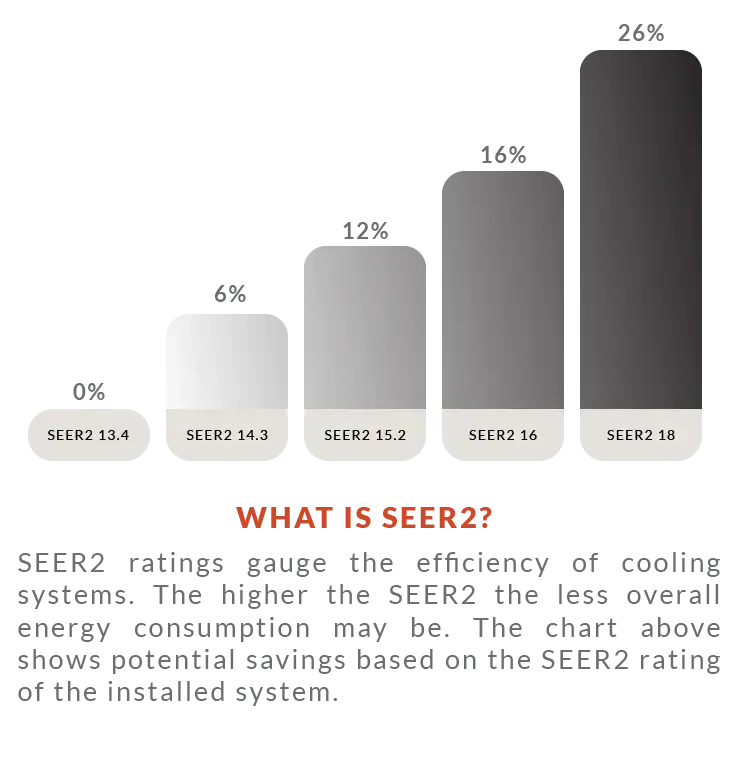
SEER2 is an energy-efficiency rating used to compare central air conditioners and heat pumps. A higher SEER2 rating indicates that equipment produced more cooling for the electricity consumed under standardized testing conditions.
That does not mean the highest available SEER2 system is automatically the best choice for every Houston home. Equipment cost, system sizing, operating stages, installation quality, ductwork, airflow, humidity control, expected ownership period, and household usage all affect the final decision.
Modern Air of Katy helps homeowners compare AC efficiency ratings and replacement options throughout Spring Branch, Memorial, Briar Forest, the Energy Corridor, Westchase, the Memorial Villages, West Houston, Katy, and nearby communities.
System sizing • Efficiency comparisons • Humidity considerations • Honest replacement options
What Does SEER Mean?
SEER2 stands for Seasonal Energy Efficiency Ratio 2.
It represents the total amount of heat removed from a conditioned space during a standardized cooling season divided by the electrical energy consumed during that testing.
SEER2 is expressed in British thermal units per watt-hour, commonly abbreviated as Btu/Wh.
In simple terms:
A higher SEER2 rating represents greater tested seasonal cooling efficiency.
SEER2 helps homeowners compare the rated efficiency of different central air conditioners and heat pumps. However, it does not predict the exact amount you will pay for electricity or guarantee how the equipment will perform in your particular home.
SEER Versus SEER2
SEER and SEER2 both describe seasonal cooling efficiency, but they come from different testing procedures.
SEER
SEER was used under an earlier federal testing procedure. Many older air conditioners, product labels, estimates, and online articles still refer to SEER.
SEER2
SEER2 is based on an updated test procedure intended to represent external static-pressure conditions more accurately than the previous procedure.
Because the test conditions changed, SEER and SEER2 should not be treated as interchangeable numbers.
An older system with a particular SEER rating should not be compared directly with a new system’s SEER2 rating as though the numbers came from the same testing process.
When reviewing new equipment, ask whether the efficiency figure is:
SEER or SEER2
Based on the exact proposed equipment combination
Certified for the matched indoor and outdoor components
Dependent on a particular furnace, air handler, coil, or blower setting
What Changed With SEER2?
The updated test procedure uses different conditions for evaluating residential air conditioners and heat pumps.
The change does not mean that older equipment suddenly became less efficient overnight. It means new equipment is being evaluated under a revised testing method.
Homeowners should know:
Older documents may list SEER.
New equipment is generally discussed using SEER2.
SEER and SEER2 values should not be compared as identical measurements.
Minimum efficiency requirements can depend on equipment type, capacity, installation region, and applicable standards.
Product ratings and standards can change over time.
Instead of relying on a permanent online table, compare the exact equipment being proposed and confirm that it meets the applicable requirements at the time of installation.
Is a Higher SEER2 Rating Better?
A higher SEER2 rating means better seasonal cooling efficiency under the applicable test procedure.
However, “better efficiency rating” does not automatically mean “better purchase” for every homeowner.
A higher-efficiency system may have:
A higher initial purchase price
More advanced controls
Two-stage or variable-capacity operation
A variable-speed indoor blower
Manufacturer-specific thermostat requirements
More complex components
Different maintenance and repair considerations
Potential comfort and noise advantages
Additional installation requirements
The added cost may make sense when the homeowner:
Uses air conditioning heavily
Plans to remain in the home for many years
Values quieter or more gradual operation
Wants improved temperature consistency
Values supported humidity-control features
Has ductwork and electrical systems compatible with the equipment
Receives a reasonable price difference between options
Can use available incentives for qualifying equipment
A simpler system may provide better value when:
The additional efficiency cost is substantial
The expected ownership period is short
The home has unresolved duct or insulation problems
Advanced features would provide limited practical benefit
Repair complexity is a major concern
Budget favors a properly installed standard-efficiency option
The right choice requires comparing equipment price, installation scope, comfort features, expected usage, and potential operating-cost differences.
Will a Higher SEER2 Air Conditioner Lower Your Electric Bill?
A higher-efficiency air conditioner may use less electricity than a lower-rated system while producing the same amount of cooling under comparable conditions.
However, your actual electric bill depends on more than the SEER2 number.
Important factors include:
Outdoor temperature and humidity
Thermostat settings
Equipment size
Cooling hours
Electricity rates
Installation quality
Refrigerant charge
Indoor airflow
Supply and return ductwork
Duct leakage
Home insulation
Window condition and sun exposure
Air leakage around the home
Household occupancy
Heat-producing appliances
Equipment maintenance
Changes in comfort habits
A homeowner who lowers the thermostat after installing a new system may not experience the expected savings. Similarly, a higher-rated system connected to leaking or restrictive ductwork may not deliver its full potential.
Specific savings should not be guaranteed based on SEER2 alone.
Rated Efficiency Versus Real-World Performance
SEER2 is produced through standardized testing. Standardized ratings are useful because they allow comparison among products under controlled conditions.
A real home is not a laboratory.
Actual system performance can be affected by:
Equipment Sizing
An oversized air conditioner may cool the home quickly and shut down before removing enough moisture. Frequent cycling may also reduce comfort and increase component starts.
An undersized system may operate for long periods and struggle to maintain the thermostat setting during peak conditions.
Proper sizing should consider the home rather than simply matching the capacity of the existing equipment.
Refrigerant Charge
An incorrect refrigerant charge may affect cooling capacity, efficiency, operating pressures, and equipment reliability.
The system should be charged and tested according to the equipment manufacturer’s instructions and installation requirements.
Indoor Airflow
The indoor blower must move an appropriate amount of air across the evaporator coil.
Restricted or incorrect airflow can affect:
Cooling capacity
Humidity removal
Coil temperature
System pressure
Energy use
Comfort
Equipment operation
Ductwork
Leaking, restrictive, poorly insulated, or incorrectly sized ducts may reduce the amount of conditioned air reaching the home.
Explore HVAC ductwork repair and installation in Houston.
Indoor and Outdoor Equipment Match
The outdoor unit, indoor coil, furnace or air handler, blower, metering device, and controls should form an approved matched system.
Installing a high-efficiency outdoor unit with an incompatible indoor component may prevent the system from achieving the expected capacity or rating.
Installation and Startup
Correct installation may involve:
Equipment placement
Refrigerant-line preparation
Electrical connections
Drainage
Duct transitions
Airflow settings
Refrigerant setup
Control configuration
Temperature testing
Pressure testing
Manufacturer-required startup steps
The equipment rating matters, but installation quality determines whether the system has a reasonable opportunity to perform as designed.
Why Matched HVAC Equipment Matters
A SEER2 rating generally applies to a tested combination of indoor and outdoor components—not only the condenser installed outside.
A matched system may include:
Outdoor air conditioner or heat pump
Indoor evaporator coil
Furnace or air handler
Blower motor and configuration
Refrigerant metering device
Thermostat or communicating control
Approved accessories
Different indoor coils or air handlers paired with the same outdoor unit may produce different capacity and efficiency ratings.
Before approving an installation, ask for:
Outdoor-unit model number
Indoor-coil model number
Furnace or air-handler model number
Matched-system efficiency rating
Cooling capacity
Heating efficiency when applicable
Equipment certification or reference information
Required thermostat or control
Manufacturer warranty information
Do not rely only on the large advertised efficiency number associated with an equipment series. Confirm the rating for the exact combination included in your proposal.
Learn more about AC installation and replacement in Houston.
SEER2 Versus EER2
SEER2 and EER2 both describe cooling efficiency, but they measure it differently.
SEER2
SEER2 represents efficiency over a standardized seasonal range of cooling conditions.
It is useful for comparing expected seasonal efficiency under the testing procedure.
EER2
EER2 represents cooling efficiency at a specified test condition rather than across an entire seasonal range.
It can provide another perspective on how equipment performs under a particular rated condition.
Neither SEER2 nor EER2 guarantees actual energy consumption in your home.
When comparing equipment for Houston, review:
SEER2
EER2
Cooling capacity
Operating stages
Indoor equipment match
Humidity-control capabilities
Manufacturer performance data
Complete installation cost
What Efficiency Ratings Apply to Heat Pumps?
A heat pump provides both cooling and heating, so it has more than one relevant efficiency measurement.
SEER2
SEER2 describes seasonal cooling efficiency.
EER2
EER2 describes cooling efficiency under a specified test condition.
HSPF2
HSPF2 stands for Heating Seasonal Performance Factor 2. It describes seasonal heating efficiency under the applicable test procedure.
Heating Capacity
A heat pump’s available heating capacity can change with outdoor temperature. Efficiency ratings alone do not explain how much heating capacity remains at a particular outdoor condition.
Auxiliary Heat
Many ducted heat-pump systems use electric auxiliary heat when the heat pump cannot meet the complete heating demand, during certain defrost conditions, or when controls call for additional heat.
Auxiliary-heat usage can materially affect electricity consumption.
Homeowners considering a heat pump should compare cooling efficiency, heating efficiency, capacity, auxiliary-heat requirements, electrical needs, and controls.
Read our comparison of a heat pump versus gas furnace in Houston.
Single-Stage, Two-Stage and Variable-Capacity Systems
Efficiency ratings do not tell the entire comfort story. The way equipment operates can also affect temperature consistency, noise, cycle length, and humidity control.
Single-Stage Air Conditioners
Single-stage equipment operates at full capacity whenever cooling is required.
Potential characteristics include:
Lower initial equipment cost
Straightforward operation
Full output during each cooling cycle
More noticeable starts and stops
Greater temperature variation in some homes
A properly sized and installed single-stage system may still provide dependable comfort.
Two-Stage Air Conditioners
Two-stage equipment can operate at a lower output during moderate conditions and use higher output when additional cooling is needed.
Potential benefits may include:
Longer low-stage cycles
More gradual cooling
Quieter operation at lower capacity
More consistent temperatures
Improved moisture removal under appropriate conditions
Actual results depend on equipment, controls, sizing, airflow, and the home.
Variable-Capacity Air Conditioners
Variable-capacity equipment can adjust cooling output across a wider operating range.
Potential benefits may include:
Longer low-capacity cycles
More consistent temperatures
Quieter operation
Reduced temperature swings
Enhanced supported humidity control
Closer response to changing cooling demand
These systems generally cost more and may require proprietary controls or specialized diagnosis.
Do not select variable-capacity equipment only because it has the highest efficiency number. Compare the features, installation requirements, warranty, repair considerations, and practical value for your home.
SEER2 and Houston Humidity Control
A high SEER2 rating does not automatically guarantee good humidity control.
Humidity performance can be affected by:
Equipment sizing
Cooling-cycle length
Compressor staging
Blower speed
Thermostat controls
Duct leakage
Return-air capacity
Building air leakage
Outdoor-air infiltration
Indoor moisture sources
Refrigerant setup
Equipment condition
An oversized high-efficiency system may cool the home rapidly but provide unsatisfactory moisture removal if it cycles off too quickly.
Two-stage and variable-capacity systems may support longer low-output cycles, which can improve moisture removal in appropriate applications. However, the equipment must be properly sized, installed, configured, and matched with suitable airflow.
For broader humidity and filtration concerns, explore our indoor air quality solutions in Houston.
Is a High-Efficiency Air Conditioner Worth the Added Cost?
A higher-efficiency system may be worth considering when the additional cost is reasonable relative to the expected benefits.
Ask:
What is the price difference between the systems?
Are the installation scopes identical?
How long do you expect to remain in the home?
How heavily do you use air conditioning?
What are your typical thermostat settings?
Does the higher-rated system include staging or comfort features?
Is a special thermostat required?
Is the existing ductwork suitable?
Does the system require electrical modifications?
What warranty applies?
Are repair parts likely to cost more?
Are qualifying incentives available?
Who verifies incentive eligibility?
What estimated savings assumptions are being used?
The highest rating may not produce the best financial return if the equipment price difference is large or the home has unresolved efficiency problems.
Likewise, choosing the lowest-priced equipment may not provide the comfort, noise level, warranty, or operating characteristics you value.
Modern Air of Katy explains the practical differences so you can select equipment appropriate for your home and budget.
How Ductwork Affects AC Efficiency
Ductwork transports conditioned air between the HVAC system and the rooms in your home.
Possible duct problems include:
Supply-air leakage
Return-air leakage
Inadequate return capacity
Undersized supply ducts
Crushed flexible duct
Excessive duct length
Sharp bends
Disconnected ducts
Damaged insulation
Poor support
Restrictive grilles
Improper system layout
A high-SEER2 air conditioner connected to severely restrictive or leaking ductwork may deliver disappointing comfort and performance.
Existing ducts do not automatically need replacement when new equipment is installed. They may remain suitable when properly sized, sealed, insulated, supported, and in serviceable condition.
Read our guide explaining when ductwork should be replaced.
Thermostats and High-Efficiency Equipment
Some two-stage, variable-capacity, communicating, and heat-pump systems require compatible controls.
Thermostat considerations may include:
Number of cooling stages
Number of heating stages
Heat-pump configuration
Auxiliary and emergency heat
Variable-capacity operation
Communicating controls
Humidity-control functions
Equipment-protection settings
Zoning compatibility
Available thermostat wiring
Common-wire requirements
A universal smart thermostat may not support every function of manufacturer-specific equipment.
Before changing controls, confirm that the proposed thermostat can operate the system correctly.
How to Compare AC Replacement Estimates
Two proposals may list similar efficiency ratings but include different equipment and installation work.
Compare:
Exact Equipment Models
Request the model numbers for the outdoor unit, indoor coil, furnace or air handler, and thermostat.
Matched-System Rating
Confirm the rated efficiency and capacity for the exact indoor and outdoor combination.
Equipment Capacity
Make sure the proposal identifies the system’s cooling capacity and how sizing was determined.
Operating Stages
Determine whether the system is single-stage, two-stage, variable-speed, or variable-capacity.
Installation Scope
Review whether the proposal includes:
Refrigerant-line work
Drainage modifications
Electrical work
Equipment pad
Disconnect
Duct transitions
Return-air improvements
Thermostat
Filter cabinet
Equipment removal
Permits when applicable
Startup and testing
Warranty Coverage
Compare:
Manufacturer parts coverage
Compressor coverage
Equipment-registration requirements
Labor coverage
Maintenance requirements
Exclusions
Transferability
Price and Financing
Compare the complete installed cost—not merely the equipment price or estimated monthly payment.
Review the factors that affect AC replacement cost in Houston.
Questions to Ask Before Choosing a SEER2 Rating
Before selecting equipment, ask your contractor:
What is the SEER2 rating of the exact matched system?
What is its rated cooling capacity?
What indoor coil and furnace or air handler are included?
Is the system single-stage, two-stage, or variable-capacity?
How was the equipment size determined?
Does the existing ductwork support the required airflow?
Is additional return air needed?
What thermostat or control is required?
How will the system manage humidity?
What electrical or drainage modifications are included?
What assumptions support the projected energy savings?
What manufacturer and labor warranties apply?
Does the equipment require registration?
What maintenance is required?
Are current rebates, credits, or utility programs available?
Who confirms eligibility for those incentives?
What testing will be performed after installation?
What work is excluded from the estimate?
Incentives and eligibility requirements can change. Confirm current terms through the applicable government agency, utility, manufacturer, or tax professional before making a purchase based on a rebate or credit.
Frequently Asked Questions About SEER2
What is a SEER2 rating?
SEER2 measures the seasonal cooling efficiency of a central air conditioner or heat pump under a standardized testing procedure. A higher rating indicates greater tested seasonal cooling efficiency.
Is SEER2 the same as SEER?
No. Both measure seasonal cooling efficiency, but SEER2 uses an updated test procedure. The values should not be compared as though they were produced under identical conditions.
What is the best SEER2 rating for a Houston home?
There is no single best rating for every home. The appropriate choice depends on equipment cost, cooling usage, ownership plans, comfort priorities, operating stages, ductwork, installation requirements, and budget.
Will a higher SEER2 system lower my electricity bill?
It may use less electricity than a lower-rated system under comparable conditions. Actual bills depend on weather, thermostat settings, equipment sizing, installation, ductwork, insulation, electricity rates, and household usage.
Does the SEER2 rating apply only to the outdoor unit?
The rated efficiency normally applies to a tested combination of indoor and outdoor components. The outdoor condenser, indoor coil, furnace or air handler, blower, controls, and setup may all affect the final rating.
Does higher SEER2 mean better humidity control?
Not automatically. Humidity control also depends on equipment sizing, cycle length, staging, blower settings, controls, airflow, duct leakage, building leakage, and moisture sources.
Is variable-capacity equipment always more efficient?
Variable-capacity systems are often available at higher efficiency levels and may provide comfort advantages. Whether the additional cost makes sense depends on the home, equipment options, usage, ownership period, and budget.
What is EER2?
EER2 describes cooling efficiency under a specified test condition. SEER2 represents efficiency across a standardized seasonal range.
What is HSPF2?
HSPF2 measures seasonal heating efficiency for applicable heat-pump equipment. Heat-pump buyers should also consider heating capacity, auxiliary heat, electrical requirements, and outdoor-temperature performance.
Should I replace a working air conditioner for a higher SEER2 rating?
Not necessarily. Consider current system reliability, repair history, comfort, energy use, warranty coverage, refrigerant type, replacement cost, and expected ownership period.
Read our guide about whether to repair or replace your air conditioner.
Can maintenance restore the original SEER2 rating?
Maintenance may address certain conditions that affect performance, but it cannot guarantee that installed equipment will achieve its laboratory rating or restore deteriorated equipment to new condition.
Schedule AC maintenance and seasonal tune-ups.
Compare AC Efficiency Options for Your Houston Home
SEER2 is a useful comparison tool, but it is only one part of choosing a new air-conditioning system.
Modern Air of Katy evaluates equipment sizing, efficiency, operating stages, humidity control, existing ductwork, airflow, controls, installation requirements, warranty coverage, and budget before recommending replacement options.
We provide residential AC installation and replacement throughout Spring Branch, Memorial, Briar Forest, the Energy Corridor, Westchase, the Memorial Villages, West Houston, Katy, and nearby communities.
Explore AC installation and replacement in Houston or contact Modern Air of Katy to discuss your home.
Modern Air of Katy — Honest HVAC Service, Done Right
Texas HVAC Contractor License TACLA30277EE