

Are upstairs rooms consistently warmer than downstairs? Does one area become uncomfortable while another receives more cooling than it needs? A properly designed HVAC zoning system may provide greater temperature control by dividing the home into separate comfort areas.
Modern Air of Katy provides HVAC zoning evaluations, installation, control upgrades, and airflow solutions throughout Spring Branch, Memorial, Briar Forest, the Energy Corridor, Westchase, the Memorial Villages, West Houston, Katy, and nearby communities.
Before recommending zoning, we evaluate the HVAC equipment, ductwork, thermostats, controls, airflow requirements, and the underlying cause of the comfort problem. Zoning can be an effective solution for an appropriate home, but it is not a substitute for repairing damaged ducts, malfunctioning equipment, inadequate insulation, or an improperly sized system.
Zoning evaluations • Motorized dampers • Zone controls • Compatible thermostats • Airflow solutions
Uneven temperatures do not always mean that a home needs HVAC zoning.
A hot upstairs room, cold downstairs area, or uncomfortable addition may result from:
Damaged or restrictive ductwork
Inadequate supply airflow
Insufficient return-air capacity
Poor air balancing
Closed or damaged dampers
Dirty filters or coils
Blower problems
Incorrect equipment settings
Refrigerant or cooling-system trouble
Improper HVAC equipment sizing
Inadequate attic insulation
Air leakage around windows or doors
Solar heat gain
Thermostat location
Changes caused by remodeling
A poorly configured existing zoning system
Modern Air of Katy evaluates the complete comfort system before recommending controls or equipment. The right correction might involve duct repair, airflow adjustment, thermostat changes, HVAC service, insulation improvements, or zoning.
If the air conditioner itself is not operating correctly, begin with professional AC repair in Houston. If damaged or improperly sized ducts are contributing to the problem, explore our HVAC ductwork repair and installation services.
An HVAC zoning system divides a home into two or more separately controlled areas. Each zone normally has a thermostat or compatible temperature sensor that communicates with a central zone-control panel.
The zone panel opens and closes motorized dampers inside the ductwork according to the temperature needs of each area. The panel also communicates with the heating and cooling equipment so that the system operates when one or more zones require conditioning.
A residential zoning system may include:
Multiple thermostats or temperature sensors
A central zone-control panel
Motorized supply-air dampers
HVAC equipment controls
Compatible wiring
Supply and return ductwork
Airflow-management components
Discharge-air or equipment-protection sensors
Optional smart-home or manufacturer-specific controls
A smart thermostat alone does not create separate HVAC zones. True zoning normally requires dampers, controls, compatible equipment, and ductwork designed to handle changing airflow.
Learn more about professional thermostat installation in Houston.
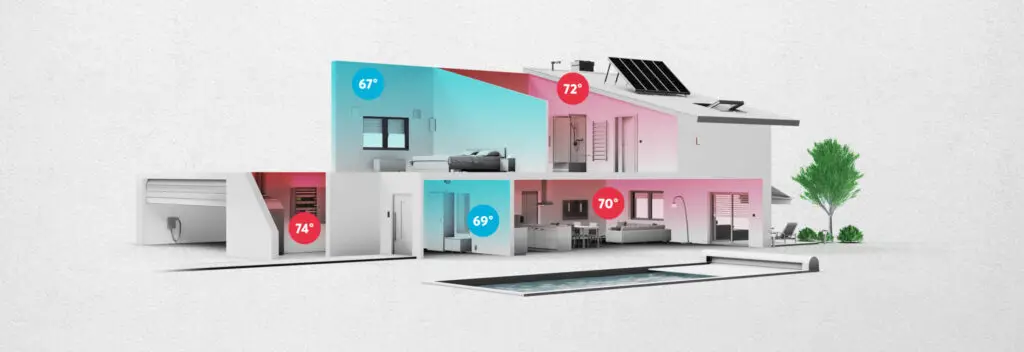
Consider a two-story home with one thermostat downstairs. During a hot Houston afternoon, the upstairs may become warmer because of attic heat, sun exposure, and natural heat movement.
If the downstairs thermostat reaches its setting before the upstairs becomes comfortable, the system may shut off too soon for the second floor.
A properly designed zoning system could separate the home into:
An upstairs zone
A downstairs zone
Each zone monitors its own temperature. If only the upstairs needs cooling, the zone-control panel opens the appropriate damper and closes or adjusts other dampers according to the system design.
Depending on the equipment, the controls may also adjust:
Cooling stages
Heating stages
Blower operation
Variable-speed airflow
Variable-capacity output
Equipment protection settings
Zoning does not necessarily mean that every room receives a separate thermostat. Most residential systems group rooms with similar use patterns and heating or cooling requirements.
Possible zone arrangements include:
Upstairs and downstairs
Living areas and sleeping areas
Main house and home addition
Primary bedroom area and common areas
Frequently used and infrequently used sections
East-facing and west-facing areas with different heat gain
The appropriate configuration depends on the home, duct layout, equipment, and comfort objectives.
Zoning may deserve consideration when the home has distinct areas with different comfort requirements.
Multi-story homes often experience different heat gains on each floor. An upstairs-downstairs zoning design may provide more precise control when the equipment and ductwork are compatible.
Separating living and sleeping spaces may reduce thermostat conflicts when those areas have different schedules or comfort preferences.
Zoning cannot provide unlimited temperature differences between adjoining areas, but it may allow reasonable independent control.
A guest suite, formal living area, home office, or other section may not require the same temperature schedule as frequently occupied areas.
Actual energy results depend on the temperature settings, equipment, ductwork, insulation, weather, and how the zones are operated.
An addition, converted garage, enclosed patio, or remodeled area may have a different heating and cooling requirement than the original house.
Zoning may be one option, but the space could instead require duct modification, additional return airflow, separate equipment, or a ductless mini-split system.
Large windows and east- or west-facing rooms may experience different heat gains throughout the day. Zoning may help manage distinct areas when the duct system and equipment support it.
Some duct layouts are more suitable for zoning than others. Distinct, accessible duct branches may make it practical to control groups of rooms with motorized dampers.
An inspection is needed to determine how the existing ducts are arranged and whether they can be modified appropriately.
Zoning controls airflow, but it cannot correct every comfort problem.
Motorized dampers cannot repair disconnected, crushed, leaking, or poorly insulated ducts. Confirmed duct problems should be corrected as part of the zoning plan.
Read our guide explaining when ductwork should be repaired or replaced.
Closing supply dampers does not solve an undersized or restrictive return system. Supply and return pathways must work together.
If the air conditioner cannot produce adequate cooling, zoning will not restore lost capacity. Electrical, refrigerant, airflow, blower, coil, compressor, and control problems should be diagnosed first.
Learn about common reasons an air conditioner may not be cooling properly.
Zoning cannot make severely oversized or undersized equipment an ideal match for the home. Equipment capacity, airflow, cycle length, humidity removal, and zone demands must be considered.
Rooms affected by inadequate insulation, air leaks, or excessive window heat gain may remain uncomfortable even after zoning. Correcting the building-related problem may provide better value.
Residential zones share walls, ceilings, doorways, and air pathways. A zoning system may provide separate control, but it cannot always maintain extreme temperature differences between adjoining areas.
A typical residential zoning system controls groups of ducts—not every supply register independently. Creating too many small zones can produce airflow and equipment-operation problems.
Ductwork is one of the most important parts of a successful zoning installation.
When dampers close, the amount of available duct area changes. If the remaining open zone cannot accept the system’s airflow, static pressure may increase.
Excessive system pressure can contribute to:
Loud airflow
Whistling registers
Duct leakage
Reduced blower performance
Equipment cycling
Temperature-limit or coil-freezing concerns
Uncomfortable drafts
Premature component stress
Poor system operation
Before adding zoning, we consider:
Supply-duct sizes
Return-air capacity
Zone configuration
Available airflow paths
Equipment airflow requirements
Blower operation
Number and size of proposed zones
Existing dampers
Duct accessibility
Duct condition and insulation
System pressure
Equipment staging or capacity control
The zoning system must be designed around the equipment and ducts. Simply installing dampers and additional thermostats does not guarantee proper operation.
HVAC equipment requires an appropriate amount of airflow to operate correctly. A zoning system changes airflow by opening and closing dampers as zone demands change.
The system design must account for the smallest possible operating zone.
Depending on the equipment and home, airflow management may involve:
Appropriate zone sizing
Staged heating or cooling
Variable-speed blower operation
Variable-capacity equipment
Modulating dampers
Damper-position limits
A designated dump zone
Duct modifications
Additional return capacity
Control-panel settings
Manufacturer-required protection controls
Other system-specific methods
Some older zoning systems use bypass ducts that route supply air back toward the return side. Bypass arrangements require careful design because excessive recirculation may create noise, temperature, humidity, efficiency, or equipment-performance concerns.
We evaluate the complete system instead of assuming one airflow-management method is right for every home.
Zoning compatibility depends partly on how the heating and cooling equipment responds when the airflow demand changes.
Single-stage equipment operates at full output whenever it runs. If only a small zone is calling, the duct system still needs a safe way to manage the equipment’s required airflow.
Zoning may be possible, but zone size, duct capacity, damper strategy, controls, and equipment protection must be evaluated carefully.
Two-stage equipment can operate at a lower output when the full capacity is unnecessary. Compatible zoning controls may use lower-stage operation when fewer zones require conditioning and higher-stage operation as demand increases.
Compatible variable-capacity equipment may adjust output and airflow across a broader operating range. This can make the system well suited to zoning when the equipment, controls, thermostats, and ductwork are designed to operate together.
Not all universal zone panels or thermostats preserve every feature of communicating or manufacturer-specific equipment.
Heat pumps, auxiliary heat, emergency heat, and dual-fuel systems require compatible zone controls and correct configuration. Improper control setup can interfere with staging, reversing-valve operation, auxiliary heat, or equipment-protection functions.
Some high-efficiency systems use proprietary controls that communicate digitally among the thermostat, indoor equipment, and outdoor unit. Adding universal zoning components may disable important functions or may not be supported.
We verify compatibility before replacing or modifying communicating controls.
If you are considering new equipment, learn about AC installation and replacement in Houston.
Thermostat room sensors and true HVAC zoning are not the same.
Compatible remote sensors allow a thermostat to monitor temperature or occupancy in selected rooms. Depending on the product, the thermostat may:
Average temperatures from several sensors
Prioritize an occupied room
Follow a scheduled sensor
Use occupancy information
Display temperatures in multiple rooms
A sensor influences how the thermostat makes decisions, but it does not independently direct airflow unless it is part of a compatible zoning system.
A true zoned HVAC system uses thermostats or sensors, a zone panel, and motorized dampers to control airflow to different areas.
Room sensors may be sufficient when the goal is to improve temperature measurement. Zoning may be more appropriate when separately controlled areas require different airflow at different times.
Neither solution repairs damaged ducts, failing equipment, inadequate insulation, or an improperly sized HVAC system.
Modern Air of Katy installs residential HVAC zoning systems when the home, equipment, controls, and ductwork are suitable.
A zoning project may include:
Designing appropriate comfort zones
Selecting compatible zone controls
Installing thermostats or sensors
Installing motorized dampers
Adding or modifying control wiring
Connecting the zone-control panel
Configuring equipment staging
Making necessary duct modifications
Addressing supply and return airflow
Installing applicable system-protection controls
Testing zone calls and damper operation
Verifying heating, cooling, and fan response
Explaining system operation to the homeowner
The project scope depends on attic access, duct layout, equipment type, existing controls, number of zones, and necessary airflow corrections.
A home with existing zoning may experience control, damper, thermostat, wiring, airflow, or equipment problems.
Signs of an existing zoning-system problem may include:
One zone does not heat or cool
A damper remains open or closed
A thermostat does not control its area
The HVAC system runs when no zone appears to be calling
Airflow becomes unusually loud
The zone panel displays an error
Heating or cooling cycles rapidly
Certain zones receive little airflow
Multiple zones do not respond
Temperatures differ significantly from thermostat readings
The system operated differently after thermostat replacement
Problems began after HVAC equipment was changed
Possible causes include:
Failed damper actuators
Damaged damper blades
Thermostat trouble
Low-voltage wiring problems
Transformer or fuse failures
Incorrect zone-panel settings
Incompatible replacement controls
Sensor problems
Equipment communication faults
Duct restrictions
Blower or HVAC equipment trouble
Poor original system design
We evaluate the controls, dampers, wiring, ductwork, airflow, and HVAC equipment before recommending a repair or redesign.
We ask which areas are uncomfortable, when the problem occurs, how the rooms are used, and what you want the zoning system to accomplish.
We identify the air conditioner, furnace, heat pump, air handler, blower, operating stages, capacity, controls, and relevant manufacturer requirements.
We examine the accessible supply and return ducts, branches, dampers, plenums, insulation, and connections.
Before recommending zoning, we consider equipment performance, duct damage, airflow restrictions, thermostat location, insulation, air leakage, window exposure, and other possible causes.
Zones should group areas with similar comfort demands while preserving appropriate airflow. We avoid creating unnecessarily small zones that the HVAC equipment and ductwork cannot serve safely.
We identify the thermostats, sensors, zone panel, motorized dampers, equipment stages, wiring, and protection controls required for the proposed system.
We explain whether the home may benefit from zoning, duct modifications, airflow correction, thermostat changes, equipment service, or another solution.
For qualifying projects, the proposal identifies the planned zones, controls, dampers, applicable duct modifications, and other included work.
We install the approved components, complete the applicable wiring and ductwork, and configure the zone controls and HVAC equipment.
We test individual and combined zone calls, damper response, thermostat operation, heating and cooling stages, airflow, and other relevant system functions.
We show you how to operate the zone thermostats or sensors and explain practical temperature settings, schedules, and system limitations.
Depending on the home and equipment, professional HVAC zoning may provide:
Separately controlled areas can respond to their own thermostat or sensor rather than relying on a single temperature reading for the entire home.
An upstairs-downstairs zoning arrangement may help address distinct temperature patterns when the system is designed appropriately.
Living, sleeping, working, and guest areas can follow different supported schedules.
Homeowners may be able to avoid maintaining every area at the same temperature continuously. Actual energy use depends on equipment, settings, weather, home construction, and how the zones are operated.
Properly matched zoning controls may work with staged or variable-capacity equipment to adjust operation as zone demands change.
Multi-story houses, additions, large floor plans, and homes with varying exposures may benefit when they can be divided into logical comfort areas.
Zoning results depend on design and installation quality. Specific comfort improvements or energy savings cannot be guaranteed without evaluating the individual home.
HVAC zoning installation cost depends on the home, equipment, ductwork, controls, access, and project scope.
Factors may include:
Number of proposed zones
Number and size of required dampers
Thermostats or sensors
Zone-control panel
Equipment type and number of stages
Communicating-control requirements
Wiring access
Duct accessibility
Supply and return modifications
Airflow-management requirements
Existing zoning components
Attic configuration
Equipment-protection controls
System testing and configuration
Adding two zones to accessible ductwork may involve a different scope than redesigning a complex multi-zone system in a large home.
A zoning estimate should identify the proposed controls, dampers, thermostats, duct modifications, and other included work so you can compare complete project scopes—not just total prices.
An air conditioner removes moisture as it cools, but humidity control depends on equipment sizing, operating cycles, airflow, thermostat settings, building leakage, outdoor conditions, and moisture sources.
Zoning may affect cycle length and airflow. An incorrectly designed system can create short operating cycles or serve zones too small for the equipment’s output.
Homes with humidity concerns should be evaluated for:
HVAC equipment sizing
Cooling-stage operation
Blower settings
Zone size
Minimum airflow
Duct leakage
Outdoor-air infiltration
Thermostat and control settings
Drainage and equipment condition
Need for dedicated humidity control
Learn more about indoor air quality and humidity solutions in Houston.
Zoned systems include controls and dampers that should be considered during routine HVAC service.
Maintenance or periodic evaluation may include:
Testing thermostat response
Checking zone-panel status
Confirming damper operation
Inspecting accessible wiring
Evaluating airflow
Checking filter condition
Testing equipment stages
Reviewing system errors
Confirming heating and cooling response
Looking for visible duct problems
Checking relevant control settings
Routine maintenance cannot prevent every control or damper failure, but it can identify certain developing problems and confirm that the HVAC equipment is operating correctly.
Schedule professional AC maintenance in Houston.

We consider the HVAC equipment, ductwork, airflow, thermostats, controls, and home conditions instead of treating every hot room as a zoning problem.
We recommend zoning when the system and home are suitable. If duct repair, equipment service, thermostat correction, or another targeted solution makes more sense, we explain why.
We evaluate equipment stages, heat-pump functions, communicating controls, wiring, dampers, and thermostats before recommending components.
We consider static pressure, return capacity, duct sizing, equipment airflow, and zone size—not only thermostats and dampers.
Modern Air of Katy is based in Spring Branch and serves homeowners throughout West Houston and nearby Katy.
Modern Air of Katy is a licensed Texas air-conditioning contractor operating under license TACLA30277E.
Local service • Straightforward recommendations • Professional installation • No high-pressure sales
EXCELLENT Based on 161 reviews
 Posted on Google
 Lindsey TankeCharles was very friendly and efficient! He arrived within 90 minutes of making the emergency call!Posted on Google
 Pinky TaheriAlways efficient timely and professional.Posted on Google
 Robert O'ByrneUnit addressed. Ok.Posted on Google
 Ashley BooherHighly recommend! Diagnosed the problem and had my AC fixed within a few hours.Posted on Google
 Russell FarleyCharles answered our call for service at 6:00am on Sunday morning. He arrived at our home shortly thereafter, measured the amp draws on the outside AC unit, and after some additional troubleshooting, isolated the problem. He replaced a bad circuit breaker and had our system cooling again within about an hour. A very satisfied Modern Air of Katy customer.Posted on Google
 Dami DinaFast and reliable service. My A/C issue was fixed within 15minutesPosted on Google
 Germaine ManningFixed my AC @ 2am….Responsive & unbelievably professional!!Posted on Google
 Menno van der HorstMy AC wasn't cooling the air after a couple power surges that happened late in the evening. I called many of the big service companies in town who all advertize to provide 24/7 service and none of them were able to come out that evening. Then I called Modern Air of Katy and Charles was at my house an hour later and got my AC unit working again. Didn't even charge an extra fee for being outside normal office hours, which a lot of other companies do charge. Couldn't be happier with their service!Posted on Google
 Todd RosenVery polite and respectful. Inexpensive as wellPosted on Google
 Daniel SotoGot home after work and the AC wasn’t cooling. Got online and started looking for people to call. Found Charles and he’s an amazing guy! Showed up and got it foxed quickly. It was a hot day so it was a last minute call.
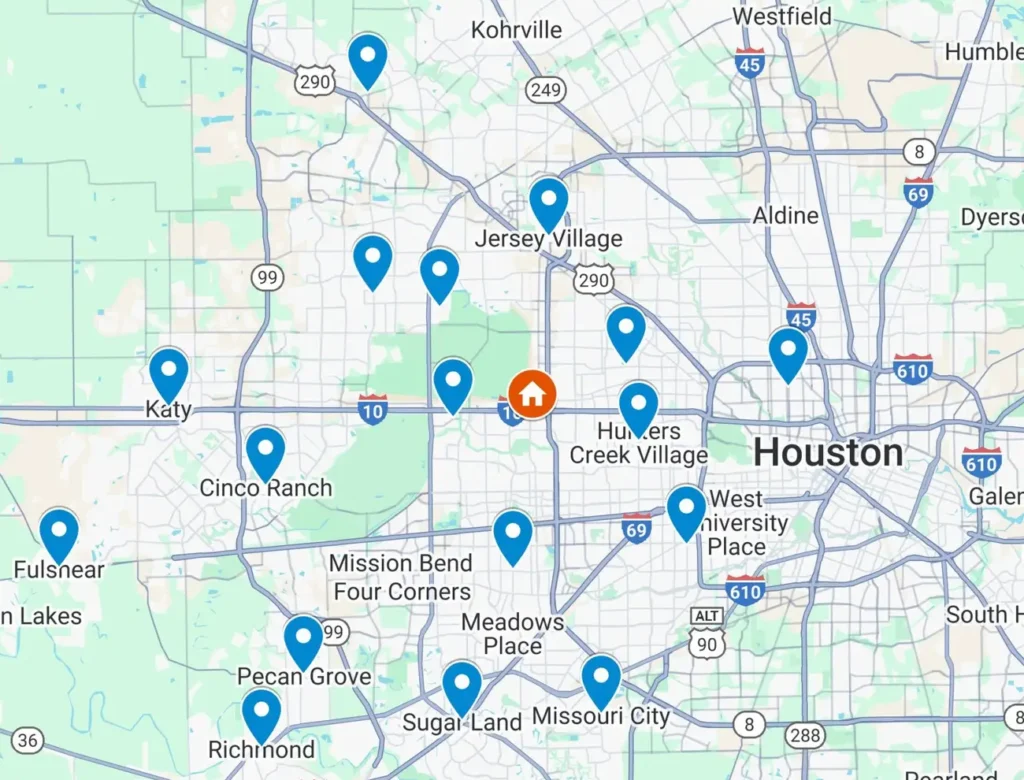
Modern Air of Katy provides HVAC zoning evaluations, installations, repairs, and airflow services throughout:
Spring Branch
Memorial
Briar Forest
Energy Corridor
Westchase
Spring Valley Village
Hedwig Village
Hunters Creek Village
Bunker Hill Village
Katy
We also serve Cypress, Sugar Land, and other nearby communities when scheduling permits.
An HVAC zoning system divides a home into separately controlled areas using compatible thermostats or sensors, a zone-control panel, and motorized duct dampers. The system directs heating or cooling to zones according to their temperature needs.
No. Zoning suitability depends on the HVAC equipment, duct layout, supply and return capacity, controls, access, zone sizes, and comfort goals. Some homes require duct or equipment changes, while others may be better served by air balancing, repairs, room sensors, or separate equipment.
Sometimes. Existing systems can be zoned when the equipment, ductwork, airflow, wiring, and controls are compatible. A professional evaluation is needed before adding dampers and zone controls.
No. Most residential zoning systems group rooms with similar use patterns and heating or cooling requirements. Creating a separate zone for every room is not always practical or appropriate.
No. Room sensors allow a compatible thermostat to monitor or prioritize temperatures in selected areas. A true zoning system uses motorized dampers and controls to direct airflow to separate zones.
Zoning may help when the upstairs and downstairs have different cooling requirements and the equipment and ductwork can support separate zones. A hot upstairs may also be caused by duct restrictions, inadequate return airflow, insulation, window exposure, air leakage, or HVAC problems.
Zoning may reduce unnecessary conditioning when temperature schedules are used appropriately. Actual energy consumption depends on the equipment, zone settings, ductwork, insulation, weather, home construction, and household usage. Specific savings cannot be guaranteed.
It may be possible, but single-stage equipment operates at full output. The system design must provide sufficient airflow when only one zone is calling. Zone sizes, duct capacity, controls, and equipment protection should be evaluated carefully.
Compatible variable-capacity equipment can adjust output across a wider operating range, which may complement zoning. The equipment, manufacturer controls, thermostats, zone panel, dampers, and ductwork must all be compatible.
Zoning alone does not guarantee humidity control. Humidity depends on equipment sizing, cycle length, airflow, controls, duct leakage, building conditions, and moisture sources. Zoning should be designed so it does not create inappropriate short cycles or airflow conditions.
The correct number depends on the layout, equipment, ductwork, area usage, and heating and cooling demands. More zones are not automatically better. Each zone must be large enough and configured to operate safely with the HVAC system.
The schedule depends on the number of zones, duct accessibility, wiring, equipment compatibility, attic conditions, and required modifications. We explain the anticipated scope and installation schedule after evaluating the home.
We can evaluate problems involving thermostats, zone panels, dampers, wiring, airflow, controls, and HVAC equipment. The repair options depend on the failed component, system design, parts availability, and compatibility of existing controls.
Not always. Existing ducts may be used when their layout, size, condition, insulation, and airflow capacity are appropriate. Some homes require damper installation, branch modifications, return-air improvements, or more extensive ductwork changes.
Modern Air of Katy — Honest HVAC Service, Done Right
Texas HVAC Contractor License TACLA30277E
A zoning system should do more than add thermostats and dampers. It must operate correctly with the HVAC equipment, ductwork, airflow requirements, and comfort needs of your home.
Modern Air of Katy evaluates the complete system and explains whether zoning, duct repair, airflow adjustment, thermostat changes, equipment service, or another solution makes sense.
We provide residential HVAC zoning services throughout Spring Branch, Memorial, Briar Forest, the Energy Corridor, Westchase, the Memorial Villages, West Houston, Katy, and nearby communities.