
If your air conditioner is leaking water inside your home, turn the cooling system off when the water could damage ceilings, walls, flooring, electrical components, or nearby property.
An AC leaking water may have a clogged condensate drain line, frozen evaporator coil, damaged drain pan, failed condensate pump, drainage installation problem, or another condition that requires professional attention.
Modern Air of Katy diagnoses and repairs AC water leaks throughout Spring Branch, Memorial, Briar Forest, the Energy Corridor, Westchase, West Houston, and nearby Katy.
Same-day appointments often available • Honest diagnostics • Upfront repair options • No high-pressure sales
Appointment availability depends on your location, current demand, and the time you call.
Water from an air conditioner can damage drywall, ceilings, flooring, insulation, and nearby property. Follow these steps when you discover an active leak:
Turn the cooling system off. Use the thermostat to set the system to “Off” if you can do so safely.
Protect the surrounding area. Move furniture and belongings away from the water. Use towels or a container to limit damage when practical.
Do not enter an unsafe attic. Wet attic surfaces, limited visibility, extreme heat, and nearby electrical equipment can create serious hazards.
Do not open HVAC electrical panels. Water and electrical equipment are a dangerous combination.
Check the air filter if it is safely accessible. A severely dirty filter can restrict airflow and contribute to evaporator-coil icing.
Call for professional service. The visible water may be the result of a drainage problem, frozen coil, airflow restriction, or refrigerant issue that needs to be diagnosed.
If water is leaking through a ceiling or near electrical equipment, leave the system off until it can be inspected.
Schedule AC Leak Repair
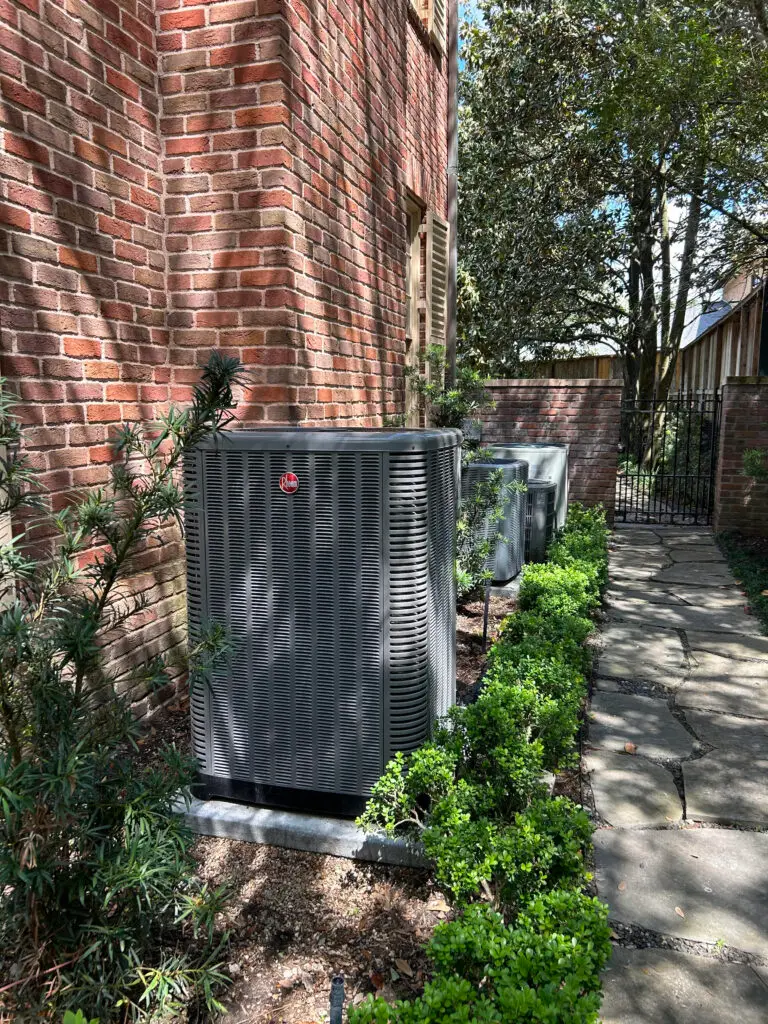
Air conditioners naturally produce condensation while removing heat and humidity from indoor air. During Houston’s cooling season, a residential AC system may remove a considerable amount of moisture.
Under normal conditions, condensation collects in the primary drain pan beneath the evaporator coil and flows through the condensate drain line to an approved discharge location. Usually to a bathroom sink. You should not normally see water pooling around the indoor equipment or leaking into the occupied areas of your home.
Water dripping from the outdoor end of a condensate drain can be normal, usually from the emergency drain pan, and indicates a clogged primary drain line that needs to be cleared. While the AC is operating. Water around the furnace or air handler, inside a secondary drain pan, coming from a ceiling, or dripping from a vent usually indicates a condition that should be investigated.
A clogged AC drain line is one of the most common causes of water around indoor HVAC equipment.
Dust, dirt, algae, biological buildup, and other debris can restrict the condensate drain. When water cannot drain properly, it may back up into the primary drain pan, overflow into a secondary pan, activate a safety switch, or leak into the surrounding area.
Some systems shut off when the drain backs up. Others may continue operating and produce additional water.
Professional service may involve clearing the obstruction, flushing the drain, checking the drain configuration, and confirming that water flows correctly before the system is returned to service.
Ice on the evaporator coil or refrigerant lines can create a significant amount of water as it melts. The resulting water may exceed the capacity of the drain pan or flow outside the intended drainage path.
An evaporator coil can freeze because of:
A severely dirty air filter
Restricted airflow
A dirty evaporator coil
A failing blower motor
Incorrect blower operation
Low refrigerant
A refrigerant-system restriction
Closed or restricted dampers
If you see ice, turn the cooling system off. You may set the thermostat fan to “On” if the blower is still moving air, but do not use tools or direct heat to remove the ice.
Thawing the system addresses the ice temporarily. The cause of the freezing still needs to be identified.
Learn What Causes a Frozen AC Unit
A dirty filter can reduce airflow across the evaporator coil. If the coil becomes too cold, condensation can freeze on its surface and later leak as the ice melts.
Other airflow problems may involve:
A dirty evaporator coil
Blocked return-air grilles
A failing blower motor
Inadequate return-air capacity
Damaged ductwork
Incorrect system settings
Replacing a dirty filter is a sensible first step, but it may not resolve an existing frozen coil or another underlying airflow problem.
The primary drain pan collects condensation beneath the evaporator coil. Over time, some pans can corrode, crack, shift, or develop leaks.
An attic system may also have a secondary pan underneath the equipment. Water in the secondary pan typically indicates that the primary drainage system has failed, overflowed, or developed a leak.
The appropriate repair depends on which pan is leaking, its accessibility, the equipment configuration, and the extent of the damage.
Many systems have a float switch or another safety control designed to stop cooling when the drain backs up.
If your air conditioner suddenly stops running and water is visible in a drain pan or drain fitting, the safety switch may have activated. This does not necessarily mean the switch is defective. It may be protecting the home from additional water damage.
The drainage problem should be corrected before the switch is reset or bypassed. A safety switch should never be permanently bypassed simply to make the system operate.
Some HVAC systems use a condensate pump when gravity drainage is not practical. A failed pump, clogged pump reservoir, stuck float, disconnected tube, or electrical problem can cause water to overflow.
The pump and discharge tubing should be inspected and tested before the system is returned to normal operation.
Condensate drains depend on properly connected and sloped piping. Water can leak when a drain fitting cracks, a connection separates, the piping sags, or the drain does not have adequate slope.
Improper drainage may cause recurring clogs, standing water, or intermittent leaks that appear only during long cooling cycles.
Some HVAC systems require a properly designed drain trap because of the pressure conditions around the evaporator coil. An incorrect, missing, or dry trap can prevent proper drainage.
Improper vent placement can also interfere with drain operation. Drainage design should be evaluated as part of the complete system rather than repeatedly clearing a line that continues to back up.
Low refrigerant can cause the evaporator coil to operate below the intended temperature and develop ice. When the system is turned off or the ice begins melting, water may overflow the drain pan.
Air conditioners do not normally consume refrigerant. If the charge is low, the system may have a leak or an earlier charging problem.
Adding refrigerant without investigating why it was lost does not correct an active leak.
Learn Why Your AC Is Not Cooling
Moisture can form on cold refrigerant lines, supply plenums, air handlers, or ductwork when insulation is missing, damaged, compressed, or improperly installed.
High attic humidity and air leakage around cold surfaces can make this problem worse. Water may then drip onto the equipment platform, attic insulation, ceiling, or floor.
This type of leak may require insulation or air-sealing correction rather than clearing the condensate drain.
A water leak can also result from installation problems such as:
Equipment that is not level
Incorrect drain slope
Improper trap or vent installation
Poorly supported drain piping
Inadequate secondary drainage protection
Incorrectly installed evaporator-coil components
Missing or damaged insulation
Drain connections that are not sealed properly
We inspect the drainage system and related equipment to determine where the water is coming from and why it is not reaching the intended drain.
An AC leaking water from the ceiling often indicates that attic-mounted HVAC equipment has developed a drainage or condensation problem.
Possible causes include:
A clogged primary condensate drain
An overflowing or damaged drain pan
A disconnected drain fitting
A frozen evaporator coil melting
A failed condensate pump
Condensation from uninsulated equipment or piping
A secondary drain that is not functioning correctly
A ceiling stain may appear some distance from the actual source because water can travel along framing, ductwork, piping, or drywall before becoming visible.
Turn the system off and avoid entering the attic if access is unsafe. HVAC repair and any required water-damage restoration are separate tasks. Stopping the HVAC leak does not automatically dry or repair affected building materials.
Water dripping from a supply vent may be caused by condensation forming on a cold vent, boot, or nearby duct surface. It can also result from an overflowing attic drain pan or another leak traveling toward the vent opening.
Contributing factors can include:
Damaged or missing duct insulation
High attic or indoor humidity
Air leakage around the vent boot
Restricted airflow
An excessively cold evaporator coil
Water leaking from attic-mounted equipment
The source should be identified before assuming that the vent itself is the problem.
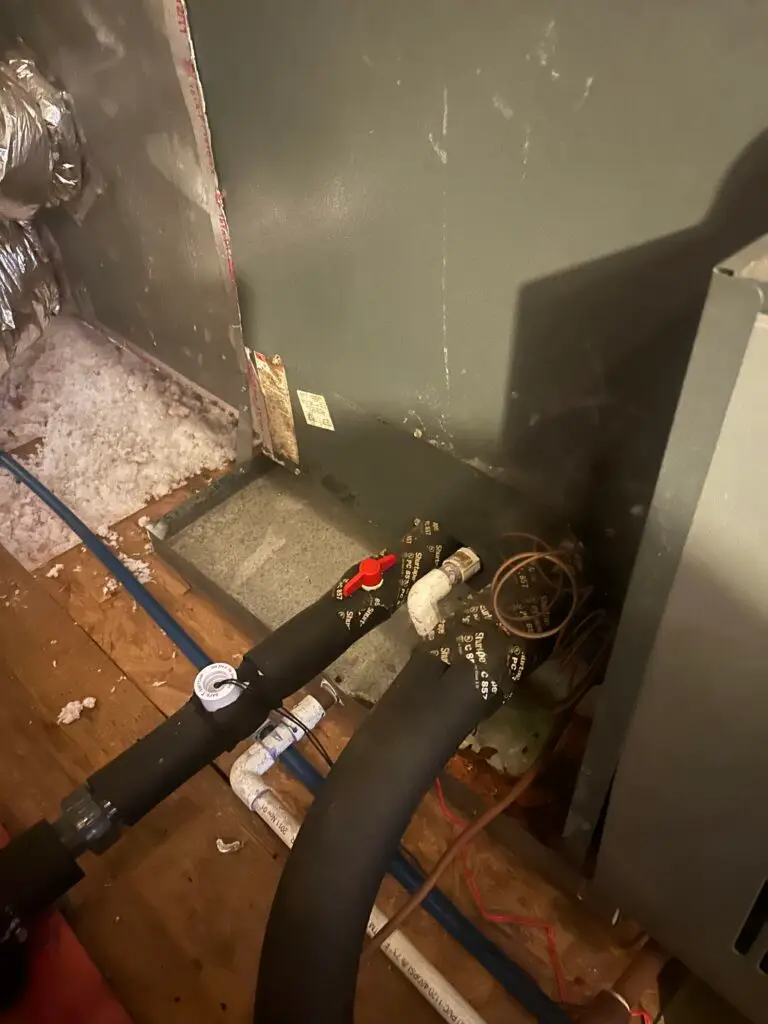
Water from an AC system is generally clear condensation. Refrigerant does not normally create a visible puddle of water.
A refrigerant leak may leave oily residue near a coil, fitting, or refrigerant line, but refrigerant usually escapes as a gas. Low refrigerant can indirectly cause water leakage by allowing the evaporator coil to freeze and later thaw.
Do not touch unidentified fluids or attempt refrigerant repairs yourself. Refrigerant diagnosis requires professional equipment and appropriate certification.
We determine whether the water originates from the evaporator coil, primary drain, secondary pan, condensate pump, refrigerant line, ductwork, or another nearby source.
We evaluate accessible drain pans, drain piping, fittings, traps, vents, safety switches, and discharge points.
If the system has frozen or is not cooling correctly, we inspect relevant airflow conditions, the air filter, blower operation, and evaporator coil.
When operating conditions indicate a possible refrigerant problem, we perform the appropriate testing to determine whether low refrigerant or another refrigeration issue contributed to the icing.
We explain what caused the leak and the work recommended to correct it. If more than one repair approach is practical, we discuss the available options before approved work begins.
After an approved repair, we test the drainage system and relevant HVAC operation to confirm that condensate is moving through the intended path.
Depending on the diagnosis, the repair may involve:
Clearing and flushing a condensate drain line
Repairing or replacing damaged drain piping
Correcting drain slope
Repairing a trap or vent configuration
Replacing a float switch
Repairing or replacing a condensate pump
Repairing or replacing a damaged drain pan
Correcting airflow restrictions
Replacing a failed blower component
Repairing insulation around refrigerant lines or ductwork
Diagnosing a refrigerant leak
Correcting an installation-related drainage problem
The correct repair depends on the source and cause of the water—not simply where the water becomes visible.
The cost to repair an air conditioner leaking water depends on the cause, equipment location, accessibility, and work required.
Clearing an accessible drain obstruction will generally cost less than replacing a damaged drain pan, repairing attic drainage, correcting a frozen-coil condition, or locating a refrigerant leak.
Factors that can affect the repair price include:
Source of the water
Type and location of the obstruction or damage
Attic or equipment accessibility
Drain-pan condition
Condensate-pump requirements
Drain-pipe repairs or modifications
Whether the evaporator coil is frozen
Whether an airflow or refrigerant problem caused the leak
System age and configuration
Parts availability and warranty coverage
We explain the diagnosis and repair options before approved work begins.
Usually, a water leak alone does not determine whether an air conditioner should be replaced. Many drainage, pump, safety-switch, insulation, and airflow problems can be repaired.
Repair may make sense when:
The drainage problem can be corrected economically
The equipment has otherwise been dependable
The evaporator coil and drain pan remain serviceable
Replacement parts are readily available
The system still provides satisfactory comfort
Useful warranty coverage remains
Replacement may deserve consideration when:
The evaporator coil or drain pan requires major work
The system has a significant refrigerant leak
Equipment is approximately 10–15 years old
Breakdowns are becoming increasingly frequent
Cooling and humidity performance have declined
Repair costs are high compared with the system’s condition
The equipment has other major problems
Modern Air of Katy will explain the immediate repair and help you compare repair and replacement when appropriate.
Routine maintenance cannot prevent every AC leak, but it may identify developing drainage, airflow, and coil problems before they cause an unexpected overflow.
Professional maintenance may include checking:
Condensate drainage
Drain-pan condition
Safety-switch operation
Air-filter condition
Evaporator-coil condition
Blower operation
Refrigerant-related performance
Visible insulation and moisture concerns
Houston air conditioners remove substantial moisture during the long cooling season, making drainage inspection particularly important.
Modern Air of Katy is based in Spring Branch and provides professional AC repair throughout:
Spring Branch
Memorial
Briar Forest
Energy Corridor
Westchase
Spring Valley Village
Hedwig Village
Hunters Creek Village
Bunker Hill Village
Katy
We also serve Cypress, Sugar Land, and other nearby communities when scheduling permits.
Schedule AC Repair in Spring Branch
Request AC Repair in Katy
View All Service Areas
area.
👉 We arrive quickly, diagnose the issue, and stop the leak at the source.

Honest diagnostics and straightforward explanations
Repair recommendations without high-pressure sales
Upfront repair options before approved work begins
Service for most major residential HVAC brands
Local, family-owned company based in Spring Branch
More than 130 five-star Google reviews
Licensed and insured Texas HVAC contractor
Texas contractor license TACLA30277E
Water around your air conditioner may appear with another cooling or airflow symptom.
Frozen AC unit: Ice forms on the coil or refrigerant line and produces water as it melts.
AC not cooling: The system operates but does not reach the thermostat setting.
AC blowing warm air: Air moves from the vents but is not being cooled.
AC not turning on: A clogged drain may activate a safety switch that shuts the system down.
Outside AC unit not running: The indoor blower may operate while the outdoor equipment remains off.
Not sure which problem you have? You do not need to diagnose the system yourself. Tell us what you see, and we will take it from there.
Yes, turn the cooling system off if water could damage the ceiling, walls, flooring, electrical equipment, or nearby property. Leave it off if you see ice, experience repeated breaker trips, or cannot determine where the water is coming from.
Possible causes include a clogged condensate drain, overflowing drain pan, damaged drain fitting, frozen evaporator coil, failed condensate pump, or condensation forming on uninsulated components.
Some homeowners perform basic drain maintenance, but drain configurations vary. Avoid entering an unsafe attic, applying excessive pressure, pouring harsh chemicals into the system, or opening HVAC panels. An incorrectly cleared line may remain partially blocked or leak at a damaged connection.
A float switch may have shut the system down to help prevent additional water damage. The drainage problem should be corrected before the switch is reset. Do not permanently bypass a drain safety switch.
A severely dirty filter can restrict airflow and contribute to evaporator-coil icing. Water may overflow when the ice melts. However, other airflow or refrigerant problems can produce the same condition.
Recurring clogs may involve biological buildup, dirt, incorrect drain slope, an improper trap or vent, standing water, or another drainage-design problem. The complete drain configuration should be evaluated when clogs repeatedly return.
No. Water in a secondary pan generally indicates that the primary drainage system has overflowed, leaked, or failed. The system should be inspected before the pan overflows.
Indirectly, yes. Low refrigerant can cause the evaporator coil to freeze. When the ice melts, the resulting water may overflow the drain pan or appear around the equipment.
Same-day appointments are often available, depending on technician availability, your location, current demand, and the time you call. Scheduling may become limited during extreme heat.
Free estimates may be available for qualifying AC installation and replacement projects. Diagnostic and repair appointments may involve a service or diagnostic charge. Contact Modern Air of Katy for current details.
If your air conditioner is leaking water, turn the cooling system off when necessary to protect your home and contact Modern Air of Katy for professional diagnosis.
We repair AC drainage, frozen-coil, airflow, condensate-pump, and related cooling problems throughout Spring Branch, Memorial, West Houston, Katy, and nearby communities.
Modern Air of Katy — Honest HVAC Service, Done Right
Texas HVAC Contractor License TACLA30277E