
Are you noticing excessive dust, musty odors, uncomfortable humidity, stale rooms, or air filters that become dirty unusually quickly?
Improving indoor air quality usually requires more than adding one filter or air-cleaning device. A complete approach may involve reducing pollutants at their source, managing moisture, providing appropriate ventilation, improving filtration, repairing duct leakage, and making sure the HVAC system operates correctly.
This guide explains practical ways to improve indoor air quality in Houston homes and how filtration, humidity, ventilation, ductwork, and HVAC performance work together.
Modern Air of Katy provides residential indoor air quality and HVAC services throughout Spring Branch, Memorial, Briar Forest, the Energy Corridor, Westchase, the Memorial Villages, West Houston, Katy, and nearby communities.
Source control • Filtration • Humidity management • Ventilation • HVAC and ductwork evaluation
Why Indoor Air Quality Can Be Challenging in Houston
Houston homes face a combination of high outdoor humidity, long cooling seasons, seasonal pollen, ordinary household dust, attic heat, outdoor particles, pets, cooking, cleaning products, and indoor moisture.
Because air conditioners operate heavily for much of the year, HVAC conditions involving filtration, drainage, evaporator coils, blowers, ductwork, and airflow can also affect indoor comfort.
Possible indoor contaminant and moisture sources include:
Cooking and combustion
Tobacco smoke
Candles and incense
Cleaning products
Paints, solvents, pesticides, and stored chemicals
Pets, carpeting, fabrics, and bedding
Outdoor pollen and dust
Remodeling and construction
Plumbing or roof leaks
Bathroom and cooking moisture
Damp building materials
Attached garages
Duct leakage
Filter bypass
Dirty or poorly maintained equipment
Inadequate ventilation
The HVAC system can influence filtration, airflow, moisture removal, and ventilation, but it is not the source of every indoor air concern. Identifying the likely source helps prevent spending money on equipment that does not address the actual problem.
For professional help, explore our indoor air quality solutions in Houston.
Signs Your Home May Have an Air Quality or Moisture Problem
No single symptom proves that a home has poor indoor air quality. However, the following conditions may deserve investigation:
Dust returns soon after cleaning
HVAC filters become dirty unusually quickly
Musty, smoky, chemical, or stale odors persist
Indoor humidity frequently feels uncomfortable
Condensation develops on windows, vents, or nearby surfaces
Air appears to leak around the filter cabinet
Dust streaks appear near supply registers
Particular rooms feel stuffy
Airflow is weak or uneven
Water collects around HVAC equipment
Visible moisture or staining appears near ducts, walls, or ceilings
Odors become noticeable when the HVAC system starts
Indoor discomfort changes by room or season
Physical symptoms can have many possible causes. An HVAC contractor can evaluate equipment, filtration, humidity, drainage, ductwork, ventilation, and airflow, but health concerns should be discussed with an appropriate healthcare professional.
1. Reduce Pollutants and Moisture at Their Source
Source control means reducing, removing, or isolating the condition producing a contaminant instead of relying entirely on a filter to capture it after it enters the air.
Practical source-control steps may include:
Avoid smoking inside the home
Use a range hood that exhausts outdoors while cooking
Use bathroom exhaust fans during and after bathing
Repair roof, plumbing, or building-envelope leaks
Dry water-damaged materials promptly
Store paints, solvents, and pesticides appropriately
Limit candles, incense, and other combustion sources
Control dust during renovation projects
Clean pet areas, fabrics, and bedding regularly
Use entrance mats and remove shoes when practical
Keep attached-garage fumes from entering the home
Address standing water and persistent condensation
Choose lower-emission products when practical
A stronger HVAC filter cannot repair a roof leak, stop a plumbing problem, remove a chemical source, or dry wet building material.
If musty odors or visible growth are connected to an active moisture source, that source must be identified and corrected. Filtration alone does not solve an ongoing water problem.
2. Use Kitchen and Bathroom Exhaust Fans
Local exhaust removes moisture and contaminants near the place where they are produced.
Kitchen Ventilation
Cooking can release moisture, odors, grease, particles, and combustion byproducts.
A range hood that exhausts outdoors can help remove these contaminants. A recirculating hood may capture some grease or particles, but it does not provide outdoor exhaust.
Use the hood while cooking and for an appropriate period afterward.
Bathroom Ventilation
Bathing and showering introduce moisture into the home. A bathroom exhaust fan can help remove that moisture before it condenses on walls, ceilings, windows, or other surfaces.
Run the fan during use and long enough afterward to reduce lingering moisture.
Kitchen and bathroom exhaust fans should discharge outdoors—not into an attic, wall cavity, or another enclosed building area.
3. Provide Appropriate Ventilation
Ventilation replaces or dilutes indoor air with outdoor air.
Ventilation may come from:
Kitchen exhaust
Bathroom exhaust
Mechanical fresh-air systems
Energy- or heat-recovery ventilators
Designed outdoor-air connections
Controlled use of windows and doors when conditions are suitable
Opening windows is not always the right strategy in Houston. Outdoor air may be extremely humid or contain high concentrations of pollen, dust, smoke, or other particles.
Bringing large amounts of untreated outdoor air into the home can increase cooling and moisture-removal demands.
A ventilation plan should consider:
Outdoor temperature and humidity
Outdoor air quality
Home construction and air tightness
Existing exhaust fans
Combustion appliances
HVAC capacity
Filtration
Indoor humidity
Location of outdoor-air intakes
Equipment controls
Tightly constructed or extensively remodeled homes may benefit from planned mechanical ventilation, but the correct approach depends on the individual property.
4. Choose an Appropriate HVAC Filter
The HVAC filter captures certain particles as return air moves back toward the heating and cooling equipment.
Filter performance depends on:
Filter media
Efficiency rating
Surface area
Size and depth
Fit
Installation direction
Airflow
System fan operation
Replacement schedule
A higher-rated filter is not automatically appropriate for every HVAC system.
An overly restrictive filter may contribute to:
Weak airflow
Longer HVAC cycles
Increased system pressure
Blower-performance problems
Reduced cooling capacity
A frozen evaporator coil
Uncomfortable humidity
Additional component stress
The goal is to use effective filtration that remains compatible with the blower, return-air system, filter cabinet, and equipment manufacturer’s requirements.
Check the Filter’s Fit
Air should pass through the filter—not around its edges.
Look for:
A correctly sized filter
No large gaps around the frame
A secure access panel
The airflow arrow pointing in the correct direction
No obvious dust streaks around the filter cabinet
An efficient filter cannot perform as expected if air bypasses it.
Check the Filter Regularly
Inspect the filter approximately once per month until you understand how quickly it becomes dirty in your home.
Replacement frequency depends on:
Filter type
Filter depth
HVAC usage
Number of occupants
Pets
Smoking
Remodeling
Outdoor conditions
Fan operating time
Manufacturer instructions
Some filters require frequent replacement, while deeper media filters may remain usable longer. Replace the filter when needed and follow the applicable product and equipment instructions.
5. Consider Whole-Home Air Filtration
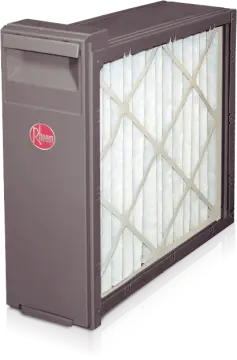
A whole-home media filter is installed as part of the central HVAC system. It filters recirculated air when the appropriate system fan operates.
Depending on the system, a properly selected media cabinet may provide:
Greater filter surface area
Improved particle capture
Better sealing around the filter
Longer service intervals
Filtration throughout the areas served by the central HVAC system
Whole-home filtration still has limitations.
It cannot:
Remove every airborne particle
Remove every gas or odor
Correct an active moisture source
Repair damaged ductwork
Prevent pollutants from being produced
Guarantee a health outcome
Filter air that never reaches the return system
Before upgrading filtration, the system should be evaluated for available space, filter fit, return-air capacity, blower performance, and acceptable pressure drop.
Modern Air of Katy can evaluate whether whole-home filtration is appropriate through our Houston indoor air quality services.
6. Use Portable Air Cleaners Appropriately
Portable air cleaners may supplement central filtration in specific rooms.
Performance depends on:
Pollutant type
Room size
Air-cleaner capacity
Filter media
Fan speed
Placement
Operating time
Maintenance
Replacement-filter condition
When comparing portable equipment:
Choose a unit appropriately sized for the room
Review its particle-removal performance
Consider noise at the speed you will actually use
Check replacement-filter availability and cost
Keep the air inlet and outlet unobstructed
Follow manufacturer instructions
Replace or clean filters when required
A portable air cleaner may help reduce certain airborne particles, but it does not correct high humidity, active mold growth, combustion problems, duct leakage, water intrusion, or pollutant sources.
Avoid products that intentionally generate ozone. Ozone should not be treated as a substitute for source control, ventilation, or filtration.
7. Control Excessive Indoor Humidity
Houston’s humid climate makes moisture management an important part of indoor comfort and air quality.
Possible signs of excessive indoor humidity include:
A sticky or clammy feeling
Persistent musty odors
Condensation on windows
Moisture around supply registers
Damp materials
Longer drying times
Discomfort despite a low thermostat setting
Conditions that can support microbial growth
Indoor humidity may be affected by:
HVAC equipment sizing
Cooling-cycle length
Airflow
Thermostat settings
Duct leakage
Building air leakage
Outdoor-air infiltration
Moisture sources
Ventilation
Air-conditioner condition
Make Sure the AC Is Operating Properly
An air conditioner removes moisture while cooling. Problems with refrigerant performance, airflow, coils, drainage, equipment settings, or cycle length may affect temperature and humidity control.
If the system runs but the house remains warm or humid, read about why an AC may not be cooling properly.
Avoid Oversized Cooling Equipment
An oversized air conditioner may cool the home rapidly and shut down before removing enough moisture.
Equipment sizing should consider the home’s actual cooling requirements rather than only its square footage or the size of the previous system.
Learn about professional AC installation and system sizing.
Consider a Whole-Home Dehumidifier
A whole-home dehumidifier may be appropriate when excessive humidity remains after identifiable moisture sources and HVAC problems are addressed.
A dehumidifier must be:
Appropriately sized
Correctly installed
Properly drained
Compatible with the HVAC system
Controlled correctly
Maintained regularly
A dehumidifier should not be used to conceal roof leaks, plumbing failures, wet insulation, foundation moisture, or other active water problems.
8. Evaluate Ductwork and Return-Air Leakage
Ductwork carries conditioned air between the HVAC equipment and occupied rooms.
Damage or leakage—especially on the return side—may pull air from an attic, wall cavity, garage-adjacent space, or another unintended area.
Possible duct-related warning signs include:
Attic odors when the system operates
Dust streaks around vents
Weak airflow in particular rooms
Hot and cold spots
Visible duct damage
Torn or wet insulation
Disconnected ducts
Excessive duct noise
Long HVAC operating cycles
Condensation on ducts or supply registers
Repairing confirmed duct leakage may reduce an unwanted pathway for dust, odors, insulation particles, and humid air.
Duct repair cannot eliminate every indoor air concern. Household activities, filtration, building leakage, ventilation, equipment cleanliness, and moisture sources may also contribute.
Duct cleaning and duct repair are different services. Cleaning does not repair crushed, disconnected, leaking, poorly insulated, or incorrectly sized ducts.
Explore HVAC ductwork repair and installation in Houston or read about when ductwork should be replaced.
9. Keep the HVAC System Properly Maintained
Professional HVAC maintenance supports equipment operation, drainage, filtration, airflow, and cooling performance.
Maintenance cannot guarantee contaminant-free air or prevent every breakdown, but it may reveal conditions that affect indoor comfort.
Depending on the equipment and service scope, a visit may include checking:
Air-filter condition
Filter fit and cabinet condition
Supply and return airflow
Blower components
Evaporator and condenser coils
Condensate drains
Drain pans and safety controls
Electrical components
Thermostat operation
Refrigerant-related performance
Accessible duct connections
Equipment cleanliness
Temperature and operating conditions
Houston cooling systems handle substantial heat and moisture for much of the year. Drainage, coil condition, airflow, and filtration deserve regular attention.
Review our HVAC maintenance guide for Houston homeowners or schedule professional AC maintenance.
10. Understand the Limits of HVAC UV Lights
Ultraviolet equipment may be installed near an evaporator coil, drain pan, or another approved location inside an HVAC system.
When properly designed, installed, positioned, and maintained, certain UV systems may help manage microbial growth on illuminated HVAC surfaces.
Effectiveness depends on:
UV wavelength and output
Placement
Distance from the target
Exposure time
Air velocity
Equipment cleanliness
Lamp age
System design
Regular maintenance
An HVAC UV light is not a complete air-cleaning system.
It does not:
Remove household dust
Capture particles
Remove gases
Eliminate every odor
Repair moisture problems
Correct duct leakage
Eliminate every airborne microorganism
UV equipment also requires appropriate shielding. Direct UV exposure can harm eyes and skin, and improper placement may damage certain HVAC materials.
Treat UV equipment as one possible component of a broader indoor air quality plan—not as a universal solution.
11. Address Water Around HVAC Equipment
Water near an indoor HVAC unit may result from:
Clogged condensate line
Damaged drain pan
Frozen evaporator coil
Failed condensate pump
Drainage installation problem
Equipment or duct condensation
Another condition requiring diagnosis
Do not ignore water around the equipment. It may damage ceilings, walls, floors, insulation, or nearby materials.
If water is actively overflowing:
Turn off cooling when it is safe to do so.
Protect the surrounding area.
Do not open electrical panels.
Schedule professional diagnosis.
Correct and dry affected materials promptly.
Learn more about why an air conditioner may be leaking water.
12. Correct Airflow and Temperature Imbalances
A room that feels stuffy or uncomfortable may have an airflow or building problem rather than an air-filtration problem.
Possible causes include:
Restricted supply ducts
Inadequate return-air pathways
Closed or damaged dampers
Dirty filters
Dirty coils
Blower problems
Incorrect equipment settings
Duct leakage
Poor insulation
Air leakage
Window exposure
Improper equipment sizing
Zoning problems
A smart thermostat may improve scheduling, monitoring, and supported humidity-control functions, but it cannot repair restrictive ductwork or create separate airflow zones by itself.
Explore professional thermostat installation in Houston or learn about HVAC zoning and airflow solutions.
When to Request a Professional Indoor Air Quality Evaluation
Consider professional HVAC and indoor-air evaluation when:
Humidity remains uncomfortable
Musty odors persist
Filters become dirty unusually quickly
Air leaks around the filter cabinet
Dust or attic odors appear when the system operates
Certain rooms have weak airflow
Condensation appears on vents or ducts
Water collects near HVAC equipment
Accessible duct damage is visible
You are considering a whole-home media filter
You are considering a dehumidifier
You want to determine whether UV equipment is appropriate
HVAC cooling or airflow performance has declined
Basic source-control and cleaning steps have not resolved the problem
Modern Air of Katy evaluates the relevant HVAC equipment, filtration, airflow, humidity, drainage, ductwork, thermostats, controls, and home conditions before recommending improvements.
The appropriate solution may involve:
Source correction
Better filter fit
Filtration upgrades
Duct repair
Airflow correction
Humidity management
Drainage repair
HVAC service
Ventilation improvements
A combination of measures
We do not assume that every home needs a UV light, dehumidifier, air purifier, or complete duct replacement.
Frequently Asked Questions About Indoor Air Quality
What is the best way to improve indoor air quality?
Start by reducing pollutant and moisture sources. Then consider appropriate ventilation, HVAC filtration, humidity control, equipment maintenance, and correction of confirmed duct or airflow problems. No single product addresses every indoor air quality concern.
What causes poor indoor air quality in Houston homes?
Possible contributors include outdoor humidity, pollen, household dust, pets, cooking, smoke, cleaning products, building leakage, inadequate ventilation, water intrusion, poorly fitting filters, duct leakage, and HVAC problems.
What type of HVAC filter should I use?
Use the most effective filter your HVAC equipment and duct system can accommodate without creating excessive airflow restriction. Filter size, depth, fit, pressure drop, blower capacity, and manufacturer requirements should all be considered.
How often should I replace my HVAC filter?
Inspect it approximately monthly until you understand how quickly it becomes dirty. Replacement frequency depends on the filter, HVAC usage, pets, occupants, household activities, construction, outdoor conditions, and manufacturer instructions.
Will a higher-MERV filter improve indoor air quality?
A higher-efficiency compatible filter may capture smaller particles, but it must fit correctly and allow adequate airflow. Installing an overly restrictive filter can reduce HVAC performance. Ask an HVAC professional if you are unsure what the system can accommodate.
Does an air purifier remove every indoor pollutant?
No. Filters and air-cleaning devices are designed to address particular contaminants under particular conditions. They cannot remove every particle, gas, odor, moisture source, or contaminant.
Can my HVAC system control indoor humidity?
A properly sized and operating air conditioner removes moisture while cooling. However, indoor humidity also depends on equipment sizing, airflow, runtime, duct leakage, building leakage, ventilation, moisture sources, and outdoor conditions. Some homes may benefit from a dedicated whole-home dehumidifier.
Does HVAC maintenance improve indoor air quality?
Maintenance may identify dirty filters, drainage restrictions, airflow problems, dirty components, or other conditions that affect HVAC performance and comfort. It does not guarantee clean air or eliminate contaminants from non-HVAC sources.
Do UV lights improve indoor air quality?
Properly designed and maintained HVAC UV equipment may help manage microbial growth on illuminated HVAC surfaces. It does not remove dust, odors, gases, or every airborne contaminant and should be considered only one part of a broader strategy.
Should I have my air ducts cleaned?
Duct cleaning is not automatically necessary in every home. The appropriate response depends on what is present and why. Damaged, leaking, crushed, disconnected, or poorly insulated ducts require repair rather than cleaning.
Can duct leaks affect indoor air quality?
Yes. A damaged return duct may pull dust, odors, insulation particles, or humid air from an attic or another unintended location. Repairing verified leakage may reduce that pathway, although other sources may still affect indoor air.
Can Modern Air of Katy test for mold?
Modern Air of Katy evaluates HVAC equipment, moisture, filtration, drainage, airflow, and duct conditions. Suspected mold contamination or health-related testing may require a qualified environmental, mold-assessment, or medical professional.
Improve the Air and Comfort in Your Houston Home
Improving indoor air quality begins with understanding the problem. Modern Air of Katy can evaluate your filtration, airflow, humidity, ductwork, drainage, thermostat, and HVAC equipment and explain the options appropriate for your home.
We provide residential indoor air quality and HVAC services throughout Spring Branch, Memorial, Briar Forest, the Energy Corridor, Westchase, Spring Valley Village, Hedwig Village, Hunters Creek Village, Bunker Hill Village, Katy, and nearby communities.
Explore our indoor air quality services in Houston or contact Modern Air of Katy with questions.
Modern Air of Katy — Honest HVAC Service, Done Right
Texas HVAC Contractor License TACLA30277E