
Uneven temperatures, weak airflow, excessive duct noise, persistent dust, and long HVAC cycles can make homeowners wonder whether their ductwork needs to be replaced.
The short answer is: not necessarily.
An isolated leak, disconnected duct, crushed section, damaged connection, or loose insulation may only require a targeted repair. Complete ductwork replacement may be appropriate when damage, deterioration, sizing problems, or poor system design affect large portions of the system.
Modern Air of Katy evaluates the HVAC equipment and accessible ductwork together before recommending repair, sealing, modification, partial replacement, or complete replacement.
We provide residential ductwork evaluations throughout Spring Branch, Memorial, Briar Forest, the Energy Corridor, Westchase, the Memorial Villages, West Houston, Katy, and nearby communities.
Duct inspections • Airflow evaluation • Duct repair and sealing • Ductwork replacement
Your Ductwork Does Not Automatically Need Replacement
Ductwork distributes heated and cooled air throughout your home. Problems with that distribution system can reduce comfort, restrict airflow, increase duct noise, or allow conditioned air to escape into an attic or another unconditioned area.
However, symptoms associated with ductwork can also result from the HVAC equipment, filter, insulation, building envelope, or thermostat.
Before replacing ducts, determine whether the actual problem involves:
Damaged or disconnected ductwork
Supply-air leakage
Return-air leakage
Crushed or sharply bent flexible ducts
Inadequate duct insulation
Improper duct sizing
Insufficient return airflow
Closed or damaged dampers
Dirty filters or coils
Blower or equipment problems
Improper HVAC equipment sizing
Refrigerant or cooling-system problems
Poor home insulation or air sealing
Excessive heat gain through windows or attic spaces
Changes made during remodeling or room additions
A complete evaluation can prevent you from replacing serviceable ductwork when the real problem is located elsewhere.
If your air conditioner is also malfunctioning, start with professional AC repair in Houston so equipment trouble is not mistaken for duct failure.
Signs Your Ductwork May Need Professional Attention
One symptom alone does not prove that the complete duct system needs replacement. The following conditions indicate that an HVAC and ductwork inspection may be worthwhile.
Uneven Temperatures Between Rooms
One room may remain warm while another receives more conditioned air than it needs. Possible duct-related causes include:
An undersized supply duct
A crushed or restricted duct
Excessive duct length
A disconnected connection
Supply-air leakage
A closed or improperly adjusted damper
Inadequate return airflow
An unbalanced system
Poor duct-system layout
Temperature differences may also result from window exposure, insulation, home air leakage, ceiling height, room additions, or equipment performance.
The cause should be identified before adding new ducts, installing zoning, or replacing HVAC equipment.
Weak Airflow From Supply Vents
Weak airflow from one vent may result from a damaged branch duct or closed damper. Weak airflow throughout the house could indicate a more widespread restriction or an equipment problem.
Possible causes include:
A dirty or restrictive air filter
A dirty evaporator coil
Blower motor trouble
Incorrect blower settings
A crushed or damaged duct
An undersized supply system
Insufficient return-air capacity
Blocked return grilles
Excessive system pressure
Improper equipment selection
Testing helps determine whether the restriction originates in the equipment, filter, return system, supply system, or a combination of components.
Visible Duct Damage
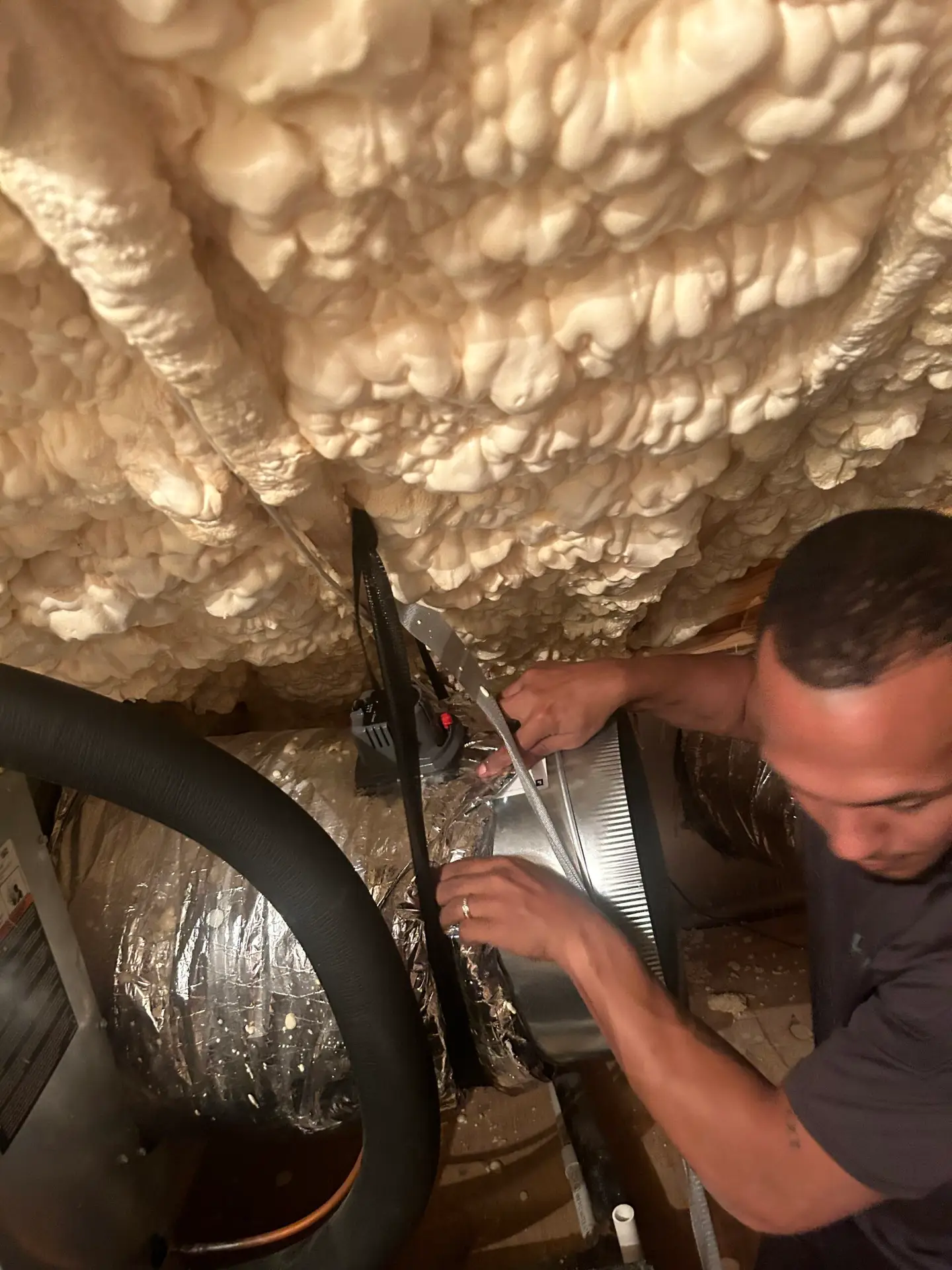
Accessible ducts in an attic, closet, garage, or mechanical area may show visible problems such as:
Disconnected duct runs
Torn or punctured outer jackets
Exposed insulation
Crushed flexible ducts
Excessive sagging
Sharp bends that restrict airflow
Loose collars or fittings
Deteriorated sealing materials
Damaged plenums
Unsupported duct sections
Wet or deteriorated insulation
Condensation around duct surfaces
Do not enter an unsafe attic to inspect your ducts. Houston attics can reach dangerous temperatures and may contain limited walking surfaces, exposed wiring, sharp materials, or fragile ceiling areas.
Excessive Duct Noise
Whistling, rattling, popping, or rushing-air sounds may indicate:
High air velocity
Restrictive grilles
Excessive system pressure
Loose metal or fittings
Duct movement
Improperly supported ducts
Incorrect blower settings
An undersized return or supply pathway
Noise alone does not determine the correct repair. The system should be evaluated before ducts, grilles, or equipment settings are changed.
Dust or Attic Odors From the Vents
Return-side duct leakage may pull air from an attic, wall cavity, garage-adjacent area, or another unintended space.
However, household dust can also originate from:
Outdoor air entering through building leaks
Pets and fabrics
Remodeling
Cooking and ordinary household activity
An incorrectly fitted filter
Gaps around the filter cabinet
Open doors and windows
Poor housekeeping access in specific areas
Duct repair may help when leakage is confirmed, but it cannot eliminate every source of household dust or indoor contaminants.
Learn about filtration, humidity, ventilation, and other ways to improve indoor air quality.
Long HVAC Operating Cycles
Leaking or restrictive ductwork may contribute to longer operating cycles because conditioned air is not being delivered effectively.
Long cycles can also result from:
Extreme outdoor temperatures
Dirty coils
Low refrigerant or refrigerant-system problems
Aging equipment
Improper system sizing
Air leakage around the home
Insulation deficiencies
Incorrect thermostat settings
Significant indoor heat gain
Ductwork should not be blamed until the HVAC system and relevant home conditions are considered.
Unexpected Energy Consumption
Damaged ducts, inadequate insulation, and conditioned-air leakage can contribute to energy loss—particularly when ducts run through a hot Houston attic.
Energy use also depends on:
Outdoor weather
Thermostat settings
Equipment efficiency
HVAC maintenance
Home insulation
Windows and solar exposure
Air leakage
Household occupancy and behavior
System sizing and condition
Correcting confirmed duct problems may improve system performance, but a particular reduction in utility bills cannot be guaranteed.
Problems That Can Look Like Ductwork Failure
Hot rooms, weak airflow, and long operating cycles do not always mean the ducts need replacement.
Before recommending extensive ductwork work, we consider other possible causes.
Dirty or Restrictive Air Filter
A dirty or overly restrictive filter can reduce airflow throughout the system. It may cause weak airflow, longer cycles, excessive blower demand, or a frozen evaporator coil.
Dirty Evaporator Coil
Dust and debris on the indoor coil may restrict airflow and interfere with heat transfer. The coil and surrounding equipment should be evaluated before assuming the duct system is undersized.
Blower Problems
A failing blower motor, dirty blower wheel, incorrect speed setting, or control problem may reduce the air delivered through otherwise usable ductwork.
Air-Conditioning Failure
Low refrigerant, dirty equipment, compressor trouble, electrical problems, and other cooling failures can make rooms feel warm even when the ducts are functioning properly.
Read about common reasons an air conditioner may not be cooling.
Home Insulation and Air Leakage
Heat entering through the attic, windows, exterior doors, or poorly sealed building areas can make a room difficult to cool. Replacing the supply duct may not correct excessive heat gain.
Thermostat Location or Control Problems
A thermostat located in an unusually warm, cool, sunny, or isolated area may not represent conditions throughout the home. Incorrect controls or zoning settings can also create comfort problems.
Room Additions and Remodeling
Enclosed patios, converted garages, expanded kitchens, and other remodeling projects may alter the home’s heating and cooling requirements. Existing ductwork may not have been modified correctly to serve the new space.
Duct Repair Versus Duct Replacement
The correct recommendation depends on the type, location, extent, and cause of the problem.
When Duct Repair May Be Enough
A targeted repair may be appropriate when most of the system remains serviceable and the problem is limited to an accessible area.
Possible repairs include:
Reconnecting a separated duct
Repairing an accessible air leak
Correcting a crushed flexible duct
Supporting a sagging duct run
Repairing a damaged connection
Replacing a limited damaged section
Repairing accessible insulation
Sealing a plenum or equipment transition
Adjusting an accessible damper
Correcting a minor airflow restriction
Repairing a specific failure may restore performance without replacing the complete duct system.
When Duct Sealing May Be Appropriate
Duct sealing addresses air escaping through loose connections, deteriorated sealing materials, fittings, plenums, or equipment transitions.
Professional sealing may involve approved HVAC mastics, tapes, gaskets, mechanical fasteners, or other appropriate materials.
Duct sealing may help:
Reduce conditioned-air leakage
Limit unintended air entering return ducts
Improve delivery to affected rooms
Correct leakage around equipment connections
Support more consistent system performance
Sealing does not correct undersized ducts, poor layout, crushed runs, inadequate returns, wet insulation, or malfunctioning HVAC equipment.
Household cloth “duct tape” is not generally suitable as a permanent HVAC duct repair.
When Partial Duct Replacement May Make Sense
Partial replacement may be appropriate when several ducts are damaged but the rest of the system remains serviceable.
Examples include:
Replacing damaged ducts serving one area
Correcting an inadequate return-air pathway
Replacing deteriorated attic ducts while retaining usable components
Modifying ducts affected by remodeling
Replacing specific runs that are incorrectly sized
Correcting a problematic section of the supply plenum
Partial replacement can sometimes address the actual problem without the cost and disruption of replacing every duct.
When Complete Ductwork Replacement May Be Appropriate
Complete replacement deserves consideration when defects are widespread or the fundamental design is unsuitable for the home and HVAC equipment.
Possible reasons include:
Multiple crushed, damaged, or disconnected ducts
Widespread deterioration
Significant moisture damage
Extensive insulation failure
Poor sizing throughout the system
Inadequate return-air capacity
An inefficient or impractical layout
Repeated repairs that do not resolve the problem
Major remodeling or additions
Ductwork incompatible with replacement HVAC equipment
Inaccessible damage that cannot be repaired practically
One uncomfortable room does not automatically justify whole-home ductwork replacement. The recommended scope should match the documented condition of the system.
For professional help, explore our HVAC ductwork repair and installation services in Houston.
Does Old Ductwork Have to Be Replaced?
Ductwork does not have a universal expiration date.
Age is relevant, but condition and design matter more. Older ductwork may remain serviceable when it is:
Properly sized
Adequately sealed
Well supported
Appropriately insulated
Free from widespread physical damage
Compatible with the HVAC equipment
Delivering acceptable airflow
Suitable for the home’s current layout
Newer ductwork can still perform poorly when it is incorrectly sized, sharply bent, compressed, poorly supported, inadequately sealed, or improperly designed.
Instead of replacing ducts solely because of age, evaluate:
Duct material
Installation quality
Physical condition
Insulation condition
Visible leakage
Supply and return capacity
System pressure
Airflow distribution
Equipment compatibility
Accessibility and repair practicality
Should Ductwork Be Replaced With a New AC System?
Installing a new air conditioner does not automatically require complete ductwork replacement.
Existing ducts may remain suitable when they are appropriately sized, sealed, insulated, in serviceable condition, and capable of handling the required airflow.
However, replacement or modification may be recommended when the existing ducts:
Cannot provide required airflow
Create excessive system pressure
Have inadequate return-air capacity
Are extensively damaged
Have widespread insulation failure
Were designed for different equipment
Do not serve the home evenly
Have been altered poorly
Cannot practically be repaired
Contribute to recurring comfort or performance problems
This evaluation is particularly important when changing equipment capacity, adding a heat pump, installing variable-capacity equipment, or modifying the home.
A high-efficiency system cannot deliver its expected comfort or performance if airflow is severely restricted or conditioned air is lost through damaged ducts.
Learn about AC installation and replacement in Houston and the factors affecting AC replacement cost in Houston.
Why Supply and Return Ducts Both Matter
The duct system includes both supply and return pathways.
Supply Ductwork
Supply ducts carry conditioned air from the HVAC equipment to individual rooms. Problems can include leakage, restrictions, damage, incorrect sizing, poor layout, and inadequate insulation.
Return Ductwork
Return ducts bring air back to the equipment for filtration, heating, or cooling.
Inadequate return airflow can contribute to:
Weak supply airflow
Excessive system pressure
Noisy operation
Reduced equipment performance
Comfort imbalance
Air being pulled through unintended openings
Return-side leakage may also draw air from attics, wall cavities, or other unintended spaces.
Adding supply air to a room without providing a suitable return pathway can create pressure and comfort problems. The entire circulation path should be considered.
Flexible Ductwork, Sheet Metal and Duct Insulation
Houston homes may contain flexible duct, sheet-metal ductwork, fiberglass duct board, or a combination of materials.
Each material has different installation and repair considerations.
Flexible Ductwork
Flexible duct must be routed and supported correctly. Excessive length, compression, sagging, or sharp bends may restrict airflow.
A flexible duct may require repair or replacement when it is crushed, torn, disconnected, contaminated by water, deteriorated, or installed in a way that significantly restricts airflow.
Sheet-Metal Ductwork
Sheet-metal ducts and plenums require secure mechanical connections, appropriate sealing, and insulation when installed in unconditioned spaces.
Surface corrosion or a small accessible leak does not always require complete replacement. The extent and cause of the damage should be evaluated.
Duct Insulation
Insulation limits heat transfer and helps reduce surface condensation when ducts travel through hot, humid attics.
Torn, missing, compressed, or wet insulation may affect performance. Wet insulation also requires determining where the moisture originated before repairs are completed.
Can Damaged Ductwork Affect Indoor Air Quality?
Damaged return ducts may pull dust, insulation particles, odors, or humid air from unintended spaces. Repairing confirmed return-side leakage may help reduce that pathway.
However, indoor air quality can also be influenced by:
Household activities
Pets
Cooking
Smoke
Cleaning products
Outdoor air
Building leakage
Moisture sources
Ventilation
Filtration
Equipment cleanliness
Plumbing or roofing problems
Replacing ductwork cannot guarantee dust-free or pollutant-free indoor air.
Duct repair and duct cleaning are also different services. Cleaning does not correct disconnected ducts, poor sizing, damaged insulation, inadequate returns, or improper layout.
For broader concerns, explore our indoor air quality solutions in Houston.
What Happens During a Professional Ductwork Evaluation?
A useful duct inspection involves more than looking briefly into a supply register.
1. Discuss the Comfort Problem
We ask which rooms are affected, when the problem occurs, whether it changes by season, and whether the home or HVAC system has been modified.
2. Evaluate HVAC Operation
The heating and cooling equipment should be considered so that an AC, blower, filter, thermostat, or coil problem is not mistaken for duct failure.
3. Inspect Accessible Ductwork
We inspect accessible supply and return ducts, plenums, connections, insulation, supports, dampers, and visible sealing materials.
4. Look for Leakage and Restrictions
We look for disconnected runs, crushed ducts, sharp bends, loose connections, damaged insulation, and other visible problems that may affect airflow.
5. Consider Airflow and System Pressure
Depending on the problem and project, evaluation may include airflow, temperature, system pressure, grille configuration, duct sizing, or other relevant operating conditions.
6. Compare Practical Solutions
We determine whether the problem may be addressed through:
Equipment service
Airflow adjustment
An isolated repair
Duct sealing
Return-air improvement
Partial replacement
Duct modification
Complete redesign or replacement
7. Explain the Recommended Scope
For larger projects, we explain which components or duct runs are being repaired, modified, or replaced and why the work is being recommended.
What Affects Ductwork Replacement Cost?
Ductwork replacement cost depends on the system and project scope rather than one universal price.
Factors may include:
Number and length of duct runs
Home size and layout
Supply and return requirements
Duct material
Insulation requirements
Attic or crawlspace accessibility
Number of floors
Existing duct condition
Plenum and transition work
Register or grille changes
Equipment compatibility
Required airflow modifications
Zoning components
Removal and disposal of old materials
Local code or project requirements
An estimate should clearly explain whether it includes complete replacement, partial replacement, sealing, insulation, plenums, returns, grilles, dampers, balancing, or other modifications.
Comparing only the total price can be misleading when contractors propose different scopes of work.
Questions to Ask Before Approving Ductwork Replacement
Before approving a major project, ask:
What specific problems were found?
Can you show me the accessible damage?
Is the problem isolated or widespread?
Could repair or partial replacement correct it?
Are the supply ducts properly sized?
Is there enough return-air capacity?
Does the HVAC equipment contribute to the problem?
Will plenums, transitions, dampers, or grilles be changed?
What duct material and insulation will be used?
How will the new ducts be supported and sealed?
Does the proposal include testing or airflow verification?
What workmanship and material warranties apply?
A clear proposal should allow you to understand what is being replaced and why.
Frequently Asked Questions About Ductwork Replacement
How do I know if my ductwork needs to be replaced?
Replacement may be appropriate when damage, insulation failure, improper sizing, poor layout, or deterioration is widespread. An isolated problem may only require repair, sealing, adjustment, or partial replacement.
How long does residential ductwork last?
There is no universal expiration date. Serviceability depends on the duct material, installation, support, insulation, attic conditions, moisture exposure, physical damage, and system design. Condition should be evaluated rather than relying only on age.
Can duct sealing fix airflow problems?
Duct sealing may correct confirmed leakage, but it cannot repair crushed ducts, inadequate returns, improper sizing, poor layout, or HVAC equipment problems.
Should I replace my ducts when replacing my air conditioner?
Not automatically. Existing ducts may be reused when they are correctly sized, sealed, insulated, in suitable condition, and compatible with the replacement equipment. Modification or replacement may be recommended when those conditions are not met.
Will replacing ductwork lower my energy bills?
Correcting significant leakage, restrictions, or insulation problems may improve system performance. Actual energy use still depends on the equipment, thermostat settings, weather, insulation, home construction, and household usage. A specific saving cannot be guaranteed.
Can damaged ducts cause excessive dust?
Return-side leakage may pull dust or particles from an attic or another unintended space. Dust can also come from outdoor air, pets, fabrics, remodeling, filter bypass, and normal household activity.
Does ductwork replacement improve indoor air quality?
Replacing damaged return ducts may reduce an identified pathway for dust, odors, insulation particles, or humid air. It cannot eliminate every indoor pollutant or guarantee a particular health result.
Can one damaged duct be replaced?
Yes. When the remainder of the system is serviceable, replacing or repairing one damaged run may be more practical than replacing the complete system.
Can ductwork cause high indoor humidity?
Leaking return ducts, damaged insulation, condensation, or poor airflow may contribute to humidity and comfort problems. High humidity can also result from equipment sizing, HVAC performance, building leakage, ventilation, or indoor moisture sources.
Can maintenance identify duct problems?
Routine AC maintenance and tune-ups may reveal visible connection, airflow, filter, or performance concerns. A separate ductwork evaluation may be needed when the problem requires more extensive inspection or system planning.
Can HVAC zoning fix uneven temperatures?
Zoning may help certain compatible homes, but it does not correct damaged, leaking, or improperly sized ductwork. Learn how HVAC zoning and airflow control work before deciding whether zoning is appropriate.
Request a Ductwork Evaluation in Houston
You should not have to replace your complete duct system simply because one room is uncomfortable or one duct is damaged.
Modern Air of Katy evaluates the HVAC equipment and accessible ductwork, explains what we find, and recommends the practical scope of work. Depending on the system, the right solution may involve repair, sealing, airflow adjustment, return-air improvement, partial replacement, or complete ductwork replacement.
We provide residential ductwork services throughout Spring Branch, Memorial, Briar Forest, the Energy Corridor, Westchase, Spring Valley Village, Hedwig Village, Hunters Creek Village, Bunker Hill Village, West Houston, Katy, and nearby communities.
Modern Air of Katy — Honest HVAC Service, Done Right
Texas HVAC Contractor License TACLA30277E